
How 1099 Per-Visit Pay Works for In-Home Physical Therapists
1099 per-visit pay means you're paid for completed visits as an independent contractor — not for hours, not for productivity dashboards. Here's how it actually works for in-home PTs, including the tax and flexibility tradeoffs to understand before you sign.
PT Near Me
Florida-licensed in-home physical therapy team
The model in one paragraph
In a 1099 per-visit arrangement, you are not an employee. You are a Florida-licensed clinician operating as an independent contractor, accepting visits from a platform that handles intake, scheduling, billing, and physician communication. You get paid a defined amount per completed and documented visit. You file taxes as self-employed. You control your schedule, your radius, and how much you work.
That's the whole model. Everything below is the practical detail.
What "per-visit" actually means
Per-visit pay means the unit of compensation is one completed visit with documentation submitted. It is not hourly. It is not salary. It is not tied to a productivity score. If you complete an eval and submit the note, you're paid for that eval. If you complete a follow-up and submit the note, you're paid for that follow-up.
Different visit types — evaluations, standard follow-ups, re-evaluations — typically carry different rates because they require different time and clinical effort. We don't publish specific rate figures on the public site; those are part of the contracting conversation and they vary by role (PT vs. PTA), region, and visit type.
1099 vs. W-2 at a glance
| W-2 employee | 1099 contractor | |
|---|---|---|
| Schedule control | Set by employer | Set by you |
| Tax withholding | Withheld from each paycheck | You pay quarterly estimated taxes |
| Self-employment tax | Employer pays half | You pay both halves (~15.3%) |
| Health insurance | Often employer-subsidized | You purchase your own |
| Retirement plan | Employer-sponsored if offered | Solo 401(k) / SEP-IRA on your own |
| Paid time off | Accrues | Not paid; you choose when to work |
| Business expenses | Reimbursed or not deductible | Deductible on Schedule C |
| Mileage | Usually reimbursed | Deductible at the IRS standard rate |
Taxes — the high-level reality
This is the part contractors most often underestimate. As a 1099 clinician you owe two things on your net earnings: federal income tax (and any state income tax, though Florida has none) and self-employment tax — the combined employer + employee share of Social Security and Medicare, currently 15.3% on net self-employment earnings up to the Social Security wage base, then 2.9% Medicare beyond that.
Most established contractor PTs handle this in a predictable way:
- Open a separate business checking account. Route 1099 income there.
- Set aside a percentage of every deposit for taxes. A common starting point is 25–35% depending on income level and deductions — your CPA will give you the right number.
- Pay quarterly estimated taxes to the IRS (Form 1040-ES) on the IRS deadlines.
- Track deductible business expenses all year: mileage, equipment, continuing education, professional licensure, liability insurance, phone, home office if applicable.
- File Schedule C and Schedule SE with your annual return.
What's typically deductible
As a self-employed clinician, your gross 1099 income is not your taxable income. You deduct legitimate business expenses first. For mobile PTs and PTAs that usually includes:
- Mileage between visits, tracked at the IRS standard business mileage rate (commuting from home to your first patient is typically not deductible — that's the home-office and tax-home conversation to have with your CPA).
- Clinical equipment: goniometers, bands, cuff weights, gait belts, BP cuff, pulse ox, treatment table if you use one.
- Professional licensure, continuing education, board renewal fees.
- Professional liability insurance.
- Phone and data plan (the business-use percentage).
- Health insurance premiums (often deductible as an above-the-line adjustment for self-employed).
- Retirement plan contributions (Solo 401(k) or SEP-IRA).
The flexibility tradeoff, honestly
The 1099 model trades guaranteed structure for guaranteed control. That cuts both ways, and the clinicians who do best in this model are the ones who understand both sides going in.
What you gain: schedule autonomy, route autonomy, treatment autonomy, the ability to scale up or down without asking permission, and a direct line between the work you do and the income you earn.
What you give up: a steady paycheck regardless of caseload, employer-paid health insurance, paid time off, employer 401(k) matching, and the back-office simplicity of "someone else withholds my taxes."
For clinicians coming out of high-volume clinic burnout, the autonomy side usually wins. For clinicians who genuinely want a fixed-hours W-2 role with full benefits, that's a real preference and 1099 isn't going to satisfy it.
If you're sizing this up
Frequently asked questions
- Will I get a W-2 or a 1099?
- A 1099 (specifically a Form 1099-NEC) for any tax year in which your contractor earnings meet the IRS reporting threshold. You file as self-employed.
- Do I have to incorporate or form an LLC?
- Not required to start. Many contractor PTs operate as sole proprietors initially and form an LLC or S-corp later as their income grows. This is a CPA conversation — the right structure depends on income, liability exposure, and state filing costs.
- How often am I paid?
- On a defined recurring schedule for completed and documented visits. Specifics are covered in the contracting conversation.
- Are travel and mileage reimbursed?
- Mileage between patient visits is generally deductible on your Schedule C at the IRS standard business mileage rate rather than reimbursed separately. Your CPA will help you set up clean mileage tracking from day one.
- Can I work for other practices at the same time?
- Yes — that's part of what it means to be 1099. Many of our clinicians also do PRN work elsewhere, teach, or run a small cash practice. The expectation is professionalism on each patient's case, not exclusivity.
- Is this article tax advice?
- No. It's general information to orient you to the model. Decisions about entity structure, deductions, retirement plans, and quarterly tax payments should be made with a CPA who works with self-employed healthcare clinicians.
Related articles
Designing Your Week as a 1099 PT: PRN, Part-Time, or a Full Caseload
One of the real advantages of contractor work is that you design the week — PRN, part-time around a W-2 role, or a full mobile caseload. Here's how each pattern actually looks for in-home PTs and PTAs.
PT Near Me · June 25, 2026
What It's Like to Be a Mobile PT with PT Near Me
A realistic day-in-the-life of a Florida mobile physical therapist: 4–6 in-home visits, one-on-one care, post-MVA caseload, no productivity quotas, and the autonomy to actually treat.
PT Near Me · June 20, 2026
How to Become a Mobile PT or PTA in Florida
A step-by-step guide to becoming a mobile, in-home physical therapist or PTA in Florida — licensure with the Florida Board of Physical Therapy, the credentials you'll need to contract, and how to actually start taking visits.
PT Near Me · June 23, 2026
In your city
Conditions we treat across Florida
Each guide below covers the clinical evidence, recovery timelines, and coverage details specific to these conditions.
Don’t see your city? View all Florida service areas.
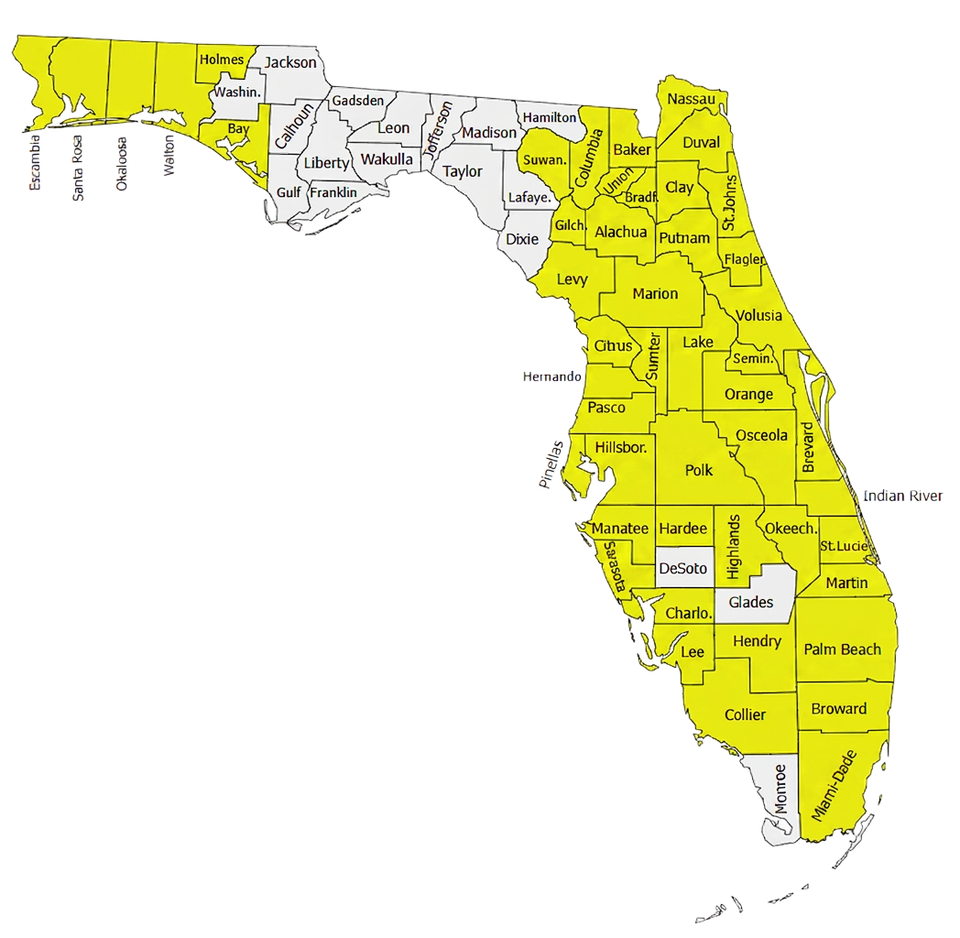
Florida-licensed physical therapists covering 50+ counties in Florida.
Our clinicians reach major metros and rural communities alike — from the Panhandle to the Keys. Patients are typically seen at home or at their workplace within 48 hours of a complete referral.
- Clinicians on our team
- Statewide
- Florida counties covered
- 50+
Need to refer a Florida patient?
Our intake team confirms auto insurance coverage during the call and schedules most patients at home or at their workplace within 48 hours.