
Recovery Guide
Recovering from a Florida car accident: a phased clinician's guide
What to do in the first 14 days, when to start auto accident physical therapy, how to keep your coverage intact, and how to make sure the medical record actually supports your recovery. Written by the Florida clinical team at PT Near Me.
Hour 0 – Day 3
Immediate care and documentation
Get medical attention even if you feel "mostly fine." Soft-tissue injuries, mild concussions, and lumbar disc symptoms often don't surface for 24 to 72 hours, and Florida law requires initial care within 14 days. If EMS doesn't transport, see your primary care doctor, an urgent care, or an ER the same day or the next morning. Save every record — the discharge paperwork, the imaging report, the work-restriction note.
Days 1 – 14
Lock in your coverage
Florida law requires you to receive initial medical care from a qualifying provider — MD, DO, dentist, PA, ARNP, or hospital — within 14 days of the crash. Missing that window can end coverage for crash-related care. Ask the provider to document your injuries fully at that first visit.
Days 3 – 21
Start physical therapy
Across cervical-spine and lumbar soft-tissue injuries, the literature consistently favors earlier intervention. A 2018 Stanford and Duke study published in JAMA Network Open (88,985 patients) found that people who started PT soon after a diagnosis of shoulder, neck, low-back, or knee pain were about 7–16% less likely to use opioids in the following months. Research on early PT after ED visits for low-back pain has also linked early PT with lower risk of lumbar surgery, lower likelihood of long-term opioid use, and lower overall cost. The CDC and the American College of Physicians both recommend non-drug treatments like PT as a first-line option for musculoskeletal pain.
Weeks 2 – 8
Stay in the plan of care
Roughly half of patients referred to outpatient PT after a car accident never complete the prescribed plan of care, and the reasons are mostly logistical — no transportation, no schedule flexibility, no clinic close enough to home. Gaps in attendance show up in the chart, and defense counsel reads them as evidence the injury wasn't real. In-home PT removes the most common reasons people drop out and keeps the documentation continuous.
Weeks 6 – 12
Manage what comes after coverage runs out
Auto insurance benefits rarely cover a full recovery episode after ER imaging and an orthopedic consult. PT Near Me does not bill regular health insurance or Medicare — if coverage is exhausted before the plan of care is complete, we talk through options with the patient before continuing.
Discharge and beyond
Document residual deficits
A real discharge summary lists subjective and objective findings on intake, the treatment course, functional progress, residual deficits, and prognostic statements. That document — not the bill — is what carriers and physicians use to understand the recovery. Make sure it exists and that your treating providers have it.
Go deeper
How soon should you start PT?
The clinical case for early intervention after a crash.
Whiplash recovery, explained
Realistic timelines and what active PT looks like.
Why patients skip PT
And why in-home delivery fixes the dropout problem.
In-home PT vs. Medicare home health
Why these aren't the same service.
Glossary of terms
MMI, MVA, ICD-10, CPT codes — defined in plain language.
FAQ hub
Everything our intake team gets asked weekly.
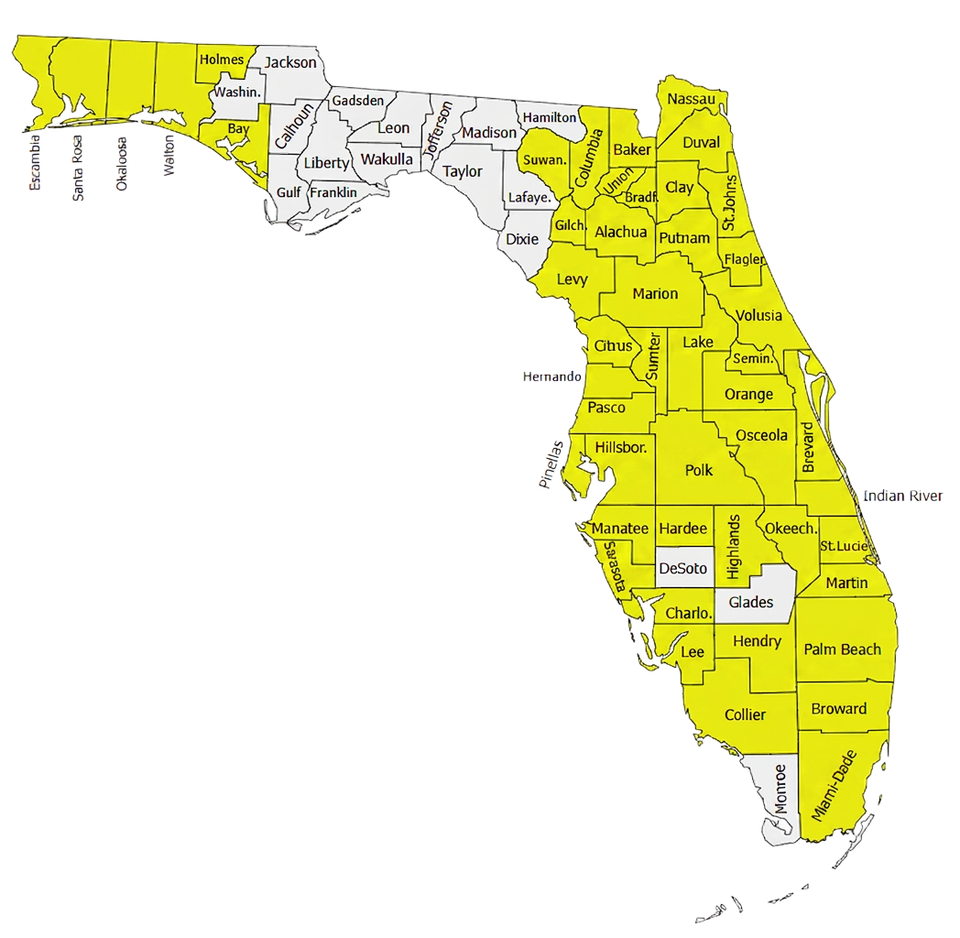
Florida-licensed physical therapists covering 50+ counties in Florida.
Our clinicians reach major metros and rural communities alike — from the Panhandle to the Keys. Patients are typically seen at home or at their workplace within 48 hours of a complete referral.
- Clinicians on our team
- Statewide
- Florida counties covered
- 50+
Get a Florida patient seen at home — usually within 48 hours.
One referral form, one call. Our intake team confirms auto insurance coverage during the call and schedules the initial evaluation.