Statewide clinical guide
Post-Fracture & Post-Cast Rehabilitation — In-Home Physical Therapy in Florida

After a fracture — whether treated with a cast, a boot, a sling, or open reduction with internal fixation — the bone has usually healed by the time PT starts, but the surrounding soft tissue is significantly compromised. Immobilization produces predictable changes: muscle protein synthesis drops within 24 hours, and skeletal muscle mass can decline by roughly 0.5–1% per day during full disuse[1][2]. Joint capsule shortening, cartilage softening from unloading, and significant loss of proprioception follow. The job of post-fracture PT is to reverse these changes safely while respecting the surgeon's weight-bearing and ROM restrictions.
The window for restoring full function is wider than for soft-tissue injury — bone heals slowly — but the consequences of skipping rehab are larger. CDC data show roughly 1 in 4 adults age 65+ falls each year and falls cause about 95% of hip fractures, with one-year mortality after hip fracture in older adults ranging from 14–58% in the published literature[3][4]. Early progressive resistance training in hip fracture rehab improves function and reduces fall recurrence[5], and AAOS guidelines for distal radius and ankle fractures both endorse early supervised motion and progressive loading once stable[6].
Common symptoms & presentation
- ·Marked loss of range of motion in the immobilized joint
- ·Visible muscle atrophy of the limb
- ·Swelling that persists after cast or boot removal
- ·Pain with initial weight-bearing or active motion
- ·Skin sensitivity or hypersensitivity over the fracture site
- ·Fear of re-injury (often the most limiting symptom)
By the numbers
- 0.5–1%daily muscle mass loss during full disuseSource [2]
- 1 in 4U.S. adults 65+ fall each year (CDC)Source [3]
- ~95%of hip fractures in older adults are caused by fallsSource [3]
- 14–58%1-year mortality after hip fracture in older adultsSource [4]
How in-home PT treats post-fracture rehab
Evaluation works directly from the orthopedic surgeon's post-op or post-cast orders: weight-bearing status, ROM restrictions, and any precautions specific to the fixation hardware. The DPT measures baseline ROM, manual muscle test grades (graded around the fracture site), swelling (circumferential measurement), and functional status (gait, transfers, ADLs). Falls-risk screening (Timed Up and Go, 30-second chair stand) is built into every lower-extremity post-fracture evaluation per CDC STEADI guidance[7].
Treatment starts with edema management (compression, elevation, retrograde massage), gentle joint mobilization within the surgeon's parameters, and isometric activation of the muscles around the fracture. As the surgeon clears progression, the program adds AROM, progressive resistance, weight-bearing progression (for lower extremity fractures), and finally proprioceptive and dynamic stability work[5]. Modalities — NMES, ice — are used selectively to support the active program.
Typical recovery timeline
Most post-fracture rehab runs 10 to 18 visits over 6 to 12 weeks. Distal radius and ankle fractures are on the shorter end; tibial plateau, calcaneus, and complex upper-extremity reconstructions are on the longer end. Without rehab after a lower-extremity fracture, older adults lose an average of 10–20% of their pre-fracture functional capacity[3].
When to escalate
These signs are not routine and warrant immediate physician contact or an ER visit.
- ·Sudden increase in pain or new deformity (rule out hardware failure or non-union)
- ·Calf swelling, warmth, or tenderness (rule out DVT)
- ·Wound dehiscence, drainage, or increasing redness (rule out infection)
- ·Loss of distal pulse, color change, or new numbness in the limb
Insurance coverage
Florida law requires the initial medical visit within 14 days of the crash. Once that window is met, PT Near Me bills the patient’s auto insurance for medically necessary in-home rehab. We do not bill regular health insurance or Medicare.
Post-Fracture Rehab PT in your Florida city
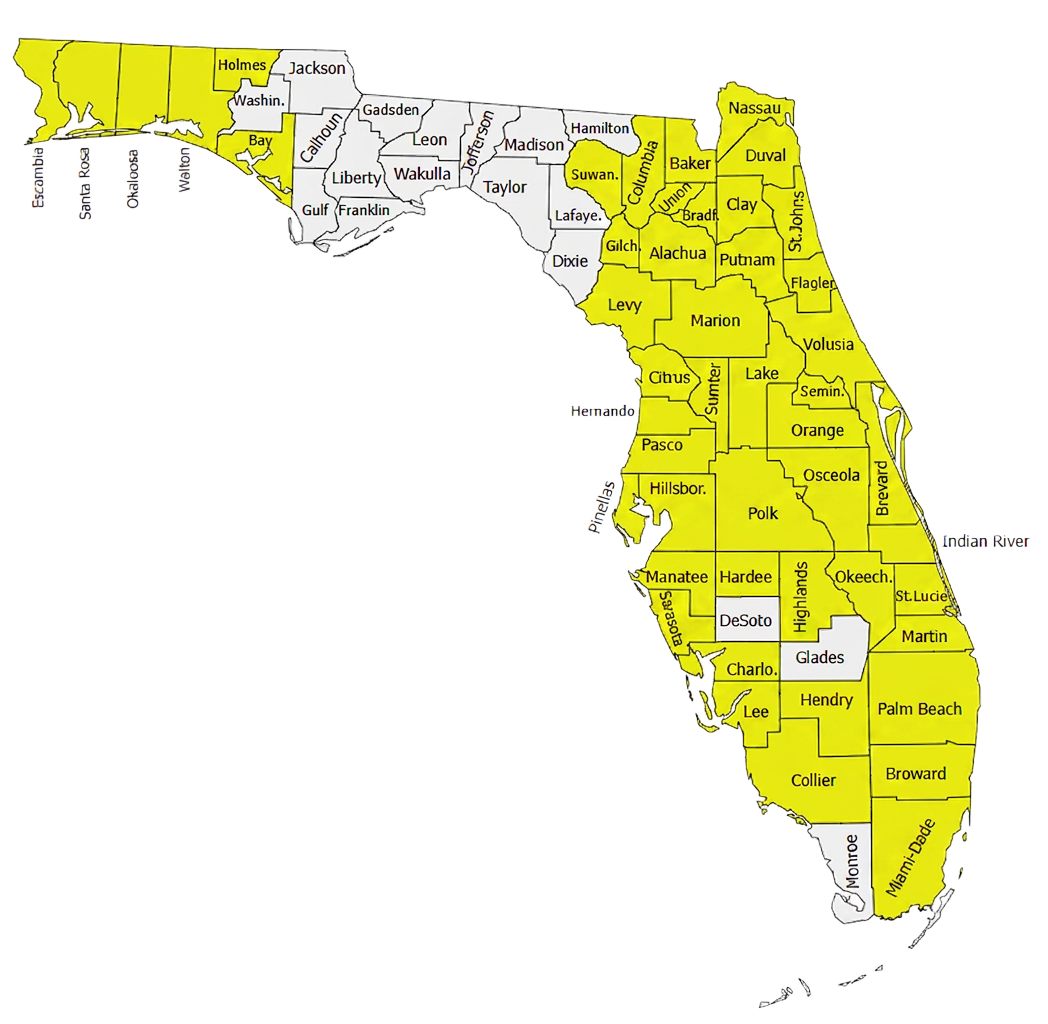
We treat post-fracture rehab across 50+ Florida counties. Pick a city to see local hospitals, crash corridors, and coverage notes for that market.
- Tampa, FLHillsborough County
- Wesley Chapel, FLPasco County
- Brandon, FLHillsborough County
- Clearwater, FLPinellas County
- St. Petersburg, FLPinellas County
- Lakeland, FLPolk County
- Orlando, FLOrange County
- Kissimmee, FLOsceola County
- Ocala, FLMarion County
- Spring Hill, FLHernando County
- Sarasota, FLSarasota County
- Bradenton, FLManatee County
- Riverview, FLHillsborough County
- Land O' Lakes, FLPasco County
- Palm Harbor, FLPinellas County
- New Port Richey, FLPasco County
- Trinity, FLPasco County
- Brooksville, FLHernando County
- Homosassa, FLCitrus County
- Hudson, FLPasco County
- Oldsmar, FLPinellas County
- Largo, FLPinellas County
- Plant City, FLHillsborough County
- Sun City Center, FLHillsborough County
- Parrish, FLManatee County
- Port Charlotte, FLCharlotte County
- Auburndale, FLPolk County
- The Villages, FLSumter County
- Wildwood, FLSumter County
- Leesburg, FLLake County
- Eustis, FLLake County
- Tavares, FLLake County
- Mount Dora, FLLake County
- Clermont, FLLake County
- Winter Garden, FLOrange County
- Apopka, FLOrange County
- Melbourne, FLBrevard County
- Daytona Beach, FLVolusia County
- Gainesville, FLAlachua County
- West Palm Beach, FLPalm Beach County
- Jupiter, FLPalm Beach County
- Fort Lauderdale, FLBroward County
- Pembroke Pines, FLBroward County
- Miami, FLMiami-Dade County
- Naples, FLCollier County
- Tallahassee, FLLeon County
- Pensacola, FLEscambia County
- Jacksonville, FLDuval County
- Fort Myers, FLLee County
- Cape Coral, FLLee County
Post-Fracture Rehab FAQ
- How soon after cast removal can PT start?
- Usually within 1–7 days. The longer the joint stays stiff after immobilization ends, the harder it is to recover full motion — early intervention matters.
- Will in-home PT work if I'm non-weight-bearing?
- Yes — and this is one of the most common reasons families call us. Driving to a clinic on crutches or in a wheelchair is logistically difficult; the DPT brings everything needed to your home.
- Do I need to bring x-rays to the evaluation?
- It helps if you have them, but it's not required. Our DPT communicates directly with the referring physician for surgical reports, weight-bearing orders, and follow-up imaging plans.
References & clinical evidence
All statistics on this page are sourced from peer-reviewed journals, clinical practice guidelines, or U.S. government health agencies.
- [1]Disuse and Functional Atrophy — review— NIH / StatPearls, 2023
- [2]Disuse atrophy: mechanisms and rates of muscle loss— Current Opinion in Clinical Nutrition, 2009
- [3]Older Adult Falls Data — STEADI— CDC
- [4]Hip fracture mortality and outcomes — systematic review— Annals of Internal Medicine, 2010
- [5]High-intensity resistance training and home-based rehabilitation after hip fracture (RCT)— JAMA, 2002
- [6]AAOS Clinical Practice Guideline — Distal Radius Fractures— AAOS, 2020
- [7]STEADI — Older Adult Fall Prevention— CDC
Related reading
Mobile Physical Therapy: The In-Home PT Guide for Florida Patients
How mobile, in-home physical therapy actually works in Florida — from referral and first visit to discharge — and when it's the right level of care.
What to Expect at Your First In-Home Physical Therapy Visit
A minute-by-minute breakdown of what happens at your first in-home physical therapy visit in Florida — what the therapist brings, how the evaluation works, and what you should have ready.
In-Home PT vs. Medicare Home Health: What's the Difference?
In-home physical therapy and Medicare home health both send a clinician to the patient's house, but they're regulated, billed, and clinically scoped very differently. After a Florida car accident, in-home PT is almost always the right fit — Medicare home health usually isn't an option at all.
Get a post-fracture rehab patient seen at home — usually within 48 hours.
Florida-licensed physical therapists covering 50+ counties in Florida.
Our clinicians reach major metros and rural communities alike — from the Panhandle to the Keys. Patients are typically seen at home or at their workplace within 48 hours of a complete referral.
- Clinicians on our team
- Statewide
- Florida counties covered
- 50+