
What to Expect at Your First In-Home Physical Therapy Visit
A minute-by-minute breakdown of what happens at your first in-home physical therapy visit in Florida — what the therapist brings, how the evaluation works, and what you should have ready.
PT Near Me
Florida-licensed in-home physical therapy team
Before the visit — what to have ready
If you have not booked yet, how in-home physical therapy works covers scheduling and coverage checks first. There's a short list of things that make the first visit faster and the documentation cleaner. None of them are required — your therapist will work with whatever you have — but the more of this you have ready, the more time you spend on care rather than paperwork.
- Auto-policy declarations page (the front sheet from your auto insurance card or policy packet) if your care is related to a crash.
- ER or hospital discharge paperwork from the day of the crash or the surgery.
- Any imaging reports you've received — X-ray, MRI, CT.
- A current medication list, including over-the-counter and supplements.
- Names and contact info for your referring physician and any specialists involved in this episode.
- Comfortable clothes you can move in — gym shorts, leggings, a t-shirt. No special clothing required.
You do not need to clear a room, set up exercise equipment, or have any particular kind of furniture. We've treated patients in studio apartments, two-story walk-ups, and assisted-living rooms. Whatever space you live in is the space we'll use.
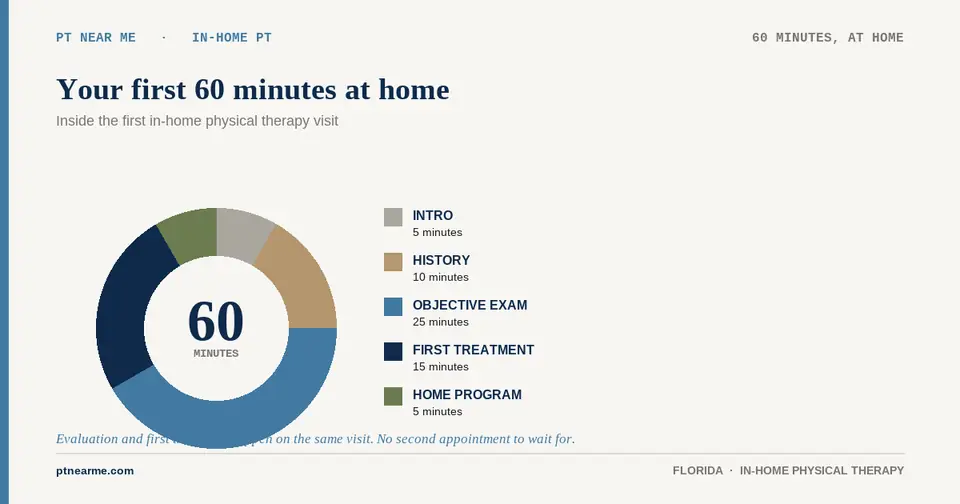
When the therapist arrives (first 5 minutes)
Your Doctor of Physical Therapy arrives within a 30-minute window of the scheduled time and calls or texts when they're a few minutes out. They'll bring a portable treatment table (about the size of a folded ironing board), a small bag of equipment, and a laptop or tablet for documentation.
The first few minutes are introductions, a quick walkthrough of the visit, and confirming the basics — name, date of birth, what hurts, and what you want out of care. If a family member or caregiver is present, the therapist will check in with them too — they're often the people running the home program between visits, so they're part of the conversation from day one.
The subjective history (next 10 minutes)
This is the conversation part. The therapist asks how the injury or surgery happened, what symptoms you have, where the pain is, what makes it worse, what makes it better, what your day looks like, what you used to be able to do before, and what you most want to get back to. It feels conversational because it is — but every answer is being mapped against a clinical framework.
Be specific. "My shoulder hurts" is less useful than "It hurts when I reach into the back seat of the car and when I try to put on a seatbelt." Specific functional examples drive the plan of care more than pain numbers do.
The objective exam (next 25 minutes)
The objective exam is the hands-on part. The therapist measures what the body is actually doing — how far each joint moves, how strong each muscle group is, how you walk, how you transfer in and out of a chair, how you climb stairs, how steady you are with your eyes closed. The specific tests depend on your diagnosis, but the categories are the same.
- Range of motion (ROM) — measured with a goniometer for relevant joints.
- Manual muscle testing (MMT) — graded 0–5 by muscle group.
- Special tests — orthopedic provocation tests specific to your suspected diagnosis.
- Gait analysis if you're walking; balance testing if fall risk is part of the picture.
- Functional assessment in your actual environment — stairs in your home, the chair you sit in, the bed you sleep in.
Many of these tests use the abbreviations you may have seen in your discharge paperwork. The PT terminology guide explains what each one means.
The plan of care and first treatment (next 15 minutes)
Before treatment starts, the therapist walks through the plan of care: what the working diagnosis is, what the prognosis looks like, what the short-term and long-term goals are, how often you'll be seen, and how long the episode is likely to run. You'll be asked to weigh in — goals are negotiated, not handed down.
Then the first treatment happens on the same visit. We don't wait until visit two. The treatment is usually a mix of hands-on manual therapy to the symptomatic area, a few therapeutic exercises that introduce the basic patterns of your program, and any pain-modulation work that's clinically indicated.
Your home exercise program (last 10 minutes)
Before the therapist leaves, you'll have a written home exercise program — usually three to seven exercises with photos or short videos, sets and reps, frequency, and clear criteria for when to call us if something feels off. We don't hand out generic sheets. The program is built for your environment, your symptoms, and your goals.
You'll also have your next visit scheduled before the therapist leaves. Typical cadence is two to three visits per week for the first few weeks, dropping to once or twice a week as you progress.
After the visit
Within 48 hours, an evaluation note is sent to your referring physician. From that point forward, the physician receives a progress note every two weeks. You don't need to do anything to make this happen — it's built into the workflow described on our how in-home physical therapy works page.
Where we treat
First-visit experience is the same regardless of city. We staff Doctors of Physical Therapy across the major Florida metros:
Full list of 47 cities on the Service Areas page.
Related reading
Frequently asked questions
- What should I wear?
- Anything you can move in — shorts, leggings, a t-shirt. The therapist may ask to see the area being treated, so easy access matters more than anything specific.
- Do I need exercise equipment?
- No. The therapist brings everything portable that's needed. Anything you'll add later (small dumbbells, a resistance band) gets recommended after the first visit if it's actually needed.
- Can a family member be present?
- Yes — and we encourage it for elderly patients, post-surgical patients, and anyone whose recovery a family caregiver is helping with.
- What if my home is small or messy?
- Doesn't matter. We've worked in studio apartments, walk-ups, and rooms with very little floor space. The therapist works with the room you have.
- Will I be in pain after the first visit?
- Some soreness for 24–48 hours is common after the evaluation. Sharp pain, new numbness, or symptoms in a new area is worth calling us about.
- How long is the first visit?
- Typically 60–75 minutes. Subsequent visits run 45–60 minutes.
- What if I have to cancel?
- Call as early as possible. We don't charge cancellation fees for active cases, but the rest of the schedule depends on rebooking quickly.
Related articles
- PT Basics & Glossary
Physical Therapy Abbreviations and Terminology: A Plain-English Glossary
PT stands for physical therapy (or physical therapist). This glossary defines the abbreviations and movement terms on your chart and home exercise program — WBAT, HEP, AROM, PROM, BLE, S/P, OOB and more.
PT Near Me · June 22, 2026
- In-Home PT
Why Auto-Accident Patients Skip PT — and How In-Home Care Fixes It
Roughly half of patients referred to outpatient physical therapy after a car accident never complete the prescribed plan of care. The reasons are mostly logistical, not medical — which is why moving treatment into the home dramatically improves attendance.
PT Near Me · April 8, 2026
- In-Home PT
In-Home PT vs. Medicare Home Health: What's the Difference?
In-home physical therapy and Medicare home health both send a clinician to the patient's house, but they're regulated, billed, and clinically scoped very differently. After a Florida car accident, in-home PT is almost always the right fit — Medicare home health usually isn't an option at all.
PT Near Me · June 22, 2026
In your city
Conditions we treat across Florida
Each guide below covers the clinical evidence, recovery timelines, and coverage details specific to these conditions.
- Concussion & Post-Concussion Symptoms
- Shoulder Injuries
- Knee & Hip Injuries
- Herniated Disc
- Post-Fracture Rehab
- Post-Surgical Rehab
Don’t see your city? View all Florida service areas.
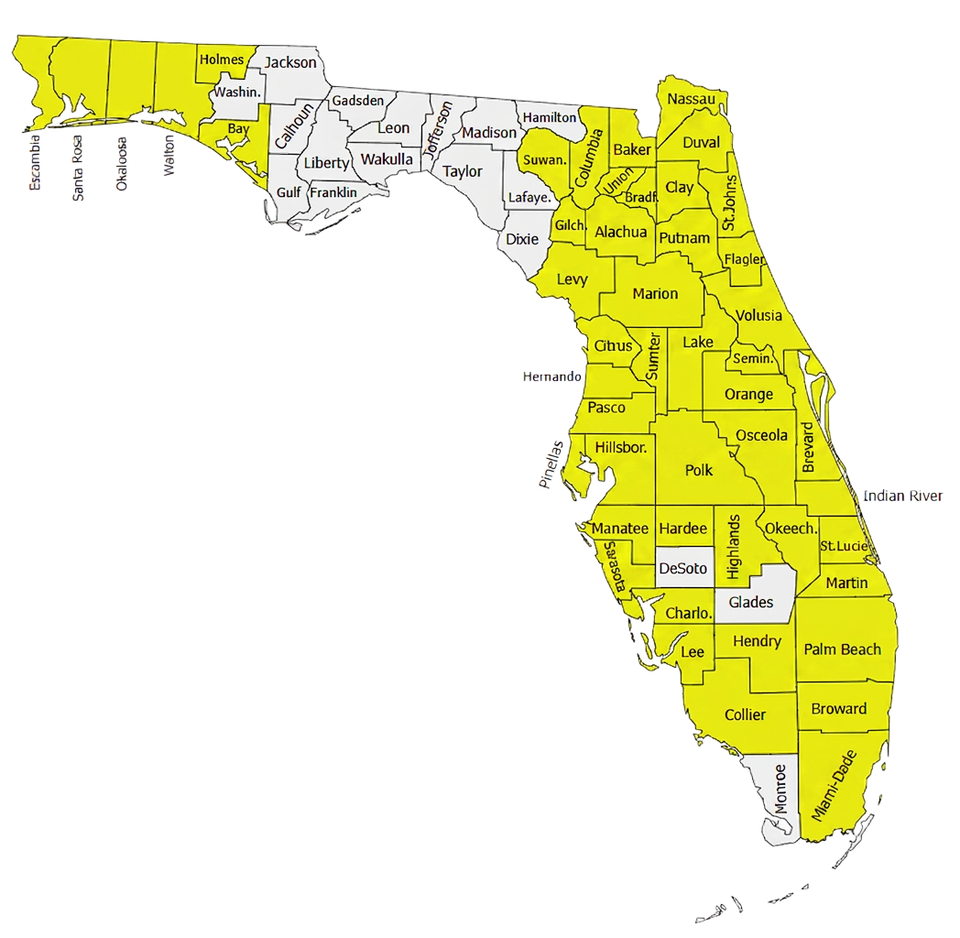
Florida-licensed physical therapists covering 50+ counties in Florida.
Our clinicians reach major metros and rural communities alike — from the Panhandle to the Keys. Patients are typically seen at home or at their workplace within 48 hours of a complete referral.
- Clinicians on our team
- Statewide
- Florida counties covered
- 50+
Need to refer a Florida patient?
Our intake team confirms auto insurance coverage during the call and schedules most patients at home or at their workplace within 48 hours.