
In-Home PT vs. Medicare Home Health: What's the Difference?
In-home physical therapy and Medicare home health both send a clinician to the patient's house, but they're regulated, billed, and clinically scoped very differently. After a Florida car accident, in-home PT is almost always the right fit — Medicare home health usually isn't an option at all.
PT Near Me
Florida-licensed in-home physical therapy team
The short answer
Both services involve a licensed clinician visiting the patient at home. That's where the similarity ends. In-home physical therapy is outpatient-equivalent PT delivered in the patient's residence — billed to auto insurance for crash-related care. Medicare home health is a separate benefit under Medicare Part A, designed for patients who are homebound after a hospitalization or significant decline in function, and delivered as a multidisciplinary episode rather than a stand-alone PT plan of care.
For a Florida patient injured in a car accident, the relevant service is in-home PT. Medicare home health is generally not available for auto-injury cases, and even when it is, the homebound requirement excludes most patients who can leave the house with assistance.
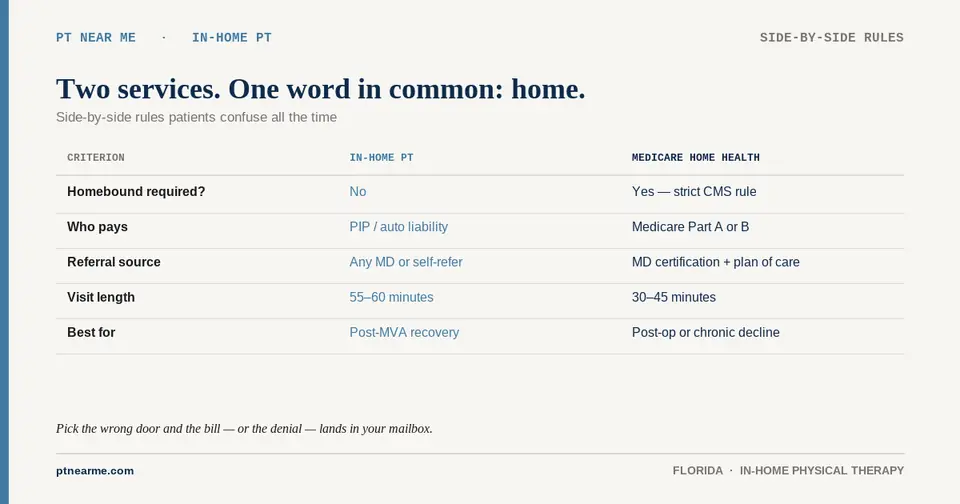
Side-by-side comparison
| In-home PT | Medicare home health | |
|---|---|---|
| Regulator | Florida state licensure | Federal Medicare (Conditions of Participation) |
| Funding | Auto insurance | Medicare Part A |
| Homebound requirement | No | Yes |
| Plan of care | PT-driven, like outpatient | Nurse-led, multidisciplinary, 60-day episodes |
| Typical case mix | Post-MVA orthopedic, post-surgical, outpatient-eligible | Post-hospitalization deconditioning, complex chronic disease |
| Visit frequency | Typically 2–3x/week, like outpatient | Variable, set by the home-health agency |
| Used for Florida auto-injury cases? | Yes — standard pathway | No, not usually appropriate |
What in-home PT actually is
In-home PT is outpatient physical therapy with the geography moved from a clinic to the patient's residence. A licensed Doctor of Physical Therapy performs the initial evaluation, builds a plan of care, and delivers the same manual therapy, therapeutic exercise, neuromuscular re-education, and progressive loading a clinic would. Visits are billed under standard outpatient CPT codes — 97161/97162/97163 for evaluations, 97110 for therapeutic exercise, 97140 for manual therapy, and so on.
There is no homebound requirement, no nurse-driven plan of care, and no episode framework. The patient can leave the house, drive, work, and travel — the in-home component is a delivery model, not a clinical restriction.
What Medicare home health is — and isn't
Medicare home health is a Part A benefit for patients who meet specific eligibility criteria, including being considered homebound. A home-health agency assigns a multidisciplinary team — typically a nurse, a PT, an OT, and a home-health aide — under a physician-certified plan of care delivered in 60-day episodes. It's designed for patients whose medical condition makes leaving the home a considerable and taxing effort, often after a hospitalization for a serious illness or surgery.
After an auto accident, most patients do not meet the homebound criteria. They can ride as passengers, attend doctor visits, and gradually return to activities — they simply can't reliably drive themselves to outpatient PT three times a week. Medicare home health is not designed for that gap. In-home outpatient PT is.
Why this matters for billing the right benefit
Billing the wrong benefit can complicate the patient's record. If treatment for an auto-related injury is run through Medicare home health, Medicare's secondary-payer rules apply and the home-health episode framework distorts the clinical record. Running auto-related PT through outpatient billing — billed to the patient's auto insurance — keeps the record clean. PT Near Me does not bill regular health insurance or Medicare.
Related resources
Frequently asked questions
- If a patient already has a home-health agency in place, can they still get in-home PT?
- Yes, when the new injury is unrelated to the condition the home-health episode is treating. The two are billed separately. Our intake team coordinates with the existing agency to avoid duplicative documentation and overlapping visits.
- Does the patient need a physician's order for in-home PT?
- Florida allows direct-access PT with limitations, but for after a crash cases — and to preserve coverage — we recommend a qualifying-provider evaluation and referral within the 14-day window before PT begins.
- Is in-home PT more expensive than clinic PT?
- No. We bill under the same outpatient CPT codes a clinic would. There is no surcharge for the in-home component; the delivery model is built around eliminating the transportation barrier, not adding cost.
- Can a patient transition from Medicare home health to in-home outpatient PT after the home-health episode ends?
- Yes, and it's a common handoff for patients who still have functional goals but no longer meet homebound criteria. We coordinate with the discharging home-health agency on the clinical baseline so the outpatient plan of care picks up where home-health left off.
Related articles
- In-Home PT
Why Auto-Accident Patients Skip PT — and How In-Home Care Fixes It
Roughly half of patients referred to outpatient physical therapy after a car accident never complete the prescribed plan of care. The reasons are mostly logistical, not medical — which is why moving treatment into the home dramatically improves attendance.
PT Near Me · April 8, 2026
- Recovering After a Crash
How Soon Should You Start PT After a Car Accident in Florida?
In Florida, the practical answer is within 14 days — both because Florida law requires initial care in that window and because the clinical evidence strongly favors early intervention for soft-tissue and cervical-spine injuries.
PT Near Me · May 2, 2026
- In-Home PT
The Cost of In-Home Physical Therapy in Florida: Auto Insurance, Cash, and What You Actually Pay
What in-home physical therapy actually costs Florida patients across auto insurance, Medicare, and cash-pay — with realistic out-of-pocket ranges and the rules that decide which one applies to your case.
PT Near Me · June 23, 2026
In your city
Conditions we treat across Florida
Each guide below covers the clinical evidence, recovery timelines, and coverage details specific to these conditions.
Don’t see your city? View all Florida service areas.
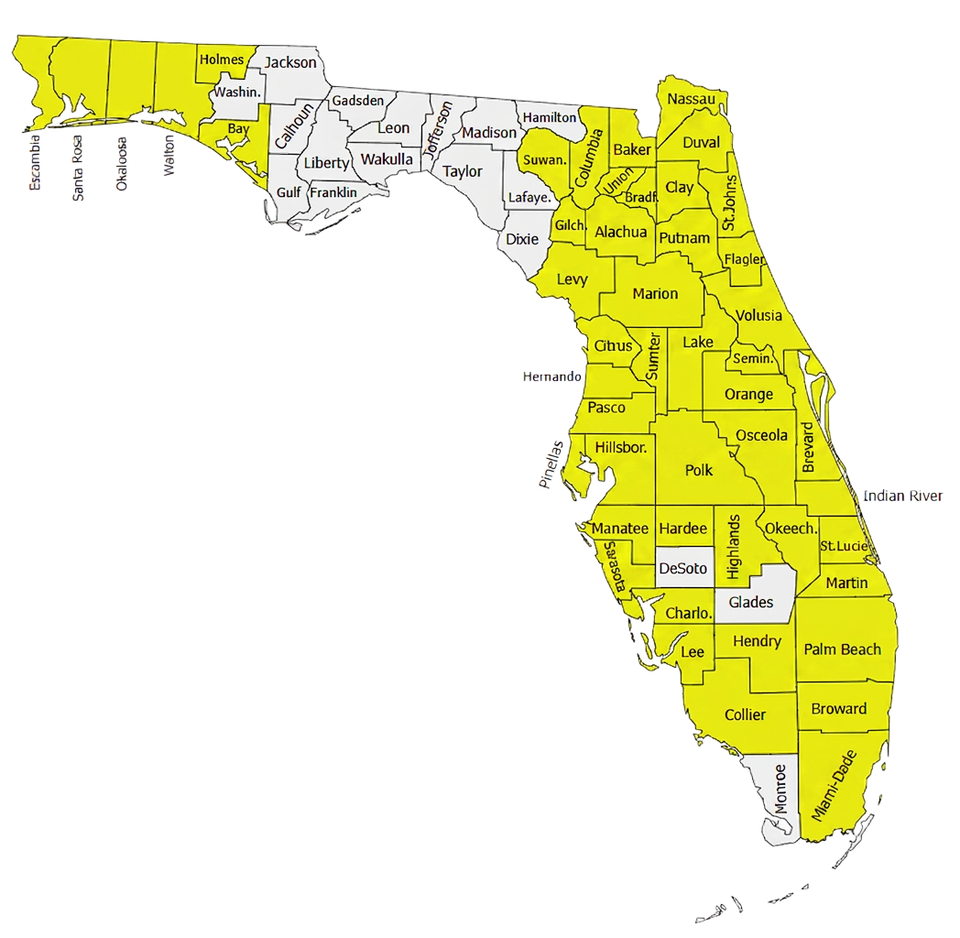
Florida-licensed physical therapists covering 50+ counties in Florida.
Our clinicians reach major metros and rural communities alike — from the Panhandle to the Keys. Patients are typically seen at home or at their workplace within 48 hours of a complete referral.
- Clinicians on our team
- Statewide
- Florida counties covered
- 50+
Need to refer a Florida patient?
Our intake team confirms auto insurance coverage during the call and schedules most patients at home or at their workplace within 48 hours.