Statewide clinical guide
Post-Surgical Orthopedic Rehabilitation — In-Home Physical Therapy in Florida

Post-surgical orthopedic rehabilitation is the highest-stakes scenario in outpatient PT: the surgeon's repair, the implant, and the patient's lifetime function all depend on the rehab being delivered on time, in sequence, and within the prescribed restrictions. AAOS data show roughly 790,000 total knee arthroplasties and 450,000 total hip arthroplasties performed annually in the U.S.[1], plus hundreds of thousands of rotator cuff repairs, ACL reconstructions, and spine procedures. The first 6 weeks after surgery are when tissue is most vulnerable to over-stress and most responsive to appropriately graded loading[2].
In-home PT is often the better delivery model for the first 4–8 weeks post-op because the patient typically can't drive, may be on opioids, and often lives alone or with a single caregiver who can't take repeated time off work. A 2017 JAMA randomized trial of post-TKA patients found home-based PT produced equivalent functional outcomes to outpatient PT at 6 and 12 months, with higher patient satisfaction[3]. Cochrane evidence supports outpatient/home PT over inpatient rehab for routine joint replacement[4]. The DPT works directly from the operating surgeon's protocol, communicates progress back to the surgical team, and transitions the patient to outpatient or independent gym-based rehab once cleared to drive.
Common symptoms & presentation
- ·Surgical pain and incision-related discomfort
- ·Significant strength loss in the operated limb
- ·Loss of range of motion (especially after immobilization)
- ·Swelling, particularly with dependent positioning
- ·Difficulty with transfers, gait, and basic ADLs
- ·Anxiety about damaging the surgical repair
By the numbers
- 790kannual U.S. total knee arthroplastiesSource [1]
- 450kannual U.S. total hip arthroplastiesSource [1]
- Equivalentoutcomes: home-based vs outpatient PT after TKA (RCT)Source [3]
- 6 weekshighest-stakes window for sticking with the protocolSource [2]
How in-home PT treats post-surgical rehab
Evaluation begins with a careful review of the operative report and the surgeon's post-op protocol: weight-bearing status, ROM restrictions, brace/sling parameters, and any precautions specific to the procedure (e.g. posterior hip precautions after total hip arthroplasty, no active flexion after rotator cuff repair). The DPT measures baseline ROM and strength within the allowed parameters and documents the patient's functional status using validated outcome measures (KOOS, HOOS, ASES, etc.)[5].
Treatment progresses through the protocol's phases — protected mobilization, progressive ROM, progressive strengthening, and return-to-function. Common procedures we treat in-home include ACL reconstruction, rotator cuff repair, total hip and knee arthroplasty, lumbar microdiscectomy, ankle ORIF, and shoulder labral repair. The APTA / JOSPT TKA CPG[6] specifies dosage and progression for joint replacement; surgeon-specific protocols govern soft-tissue repairs.
Typical recovery timeline
Most post-surgical episodes run 16 to 36 visits over 3 to 6 months, with frequency typically 2–3 visits per week in the early phase tapering to 1 visit per week or every-other-week by the end. Post-TKA patients who complete a structured 12-week PT program show significantly better function at 1 year than those who don't[3]. The exact dosage follows the surgeon's protocol.
When to escalate
These signs are not routine and warrant immediate physician contact or an ER visit.
- ·Wound dehiscence, drainage, or increasing redness/warmth (rule out infection)
- ·Sudden increase in pain or new instability (rule out hardware failure or repair disruption)
- ·Calf swelling, warmth, or tenderness; chest pain or shortness of breath (rule out DVT/PE)
- ·Fever > 101°F or chills
Insurance coverage
Florida law requires the initial medical visit within 14 days of the crash. Once that window is met, PT Near Me bills the patient’s auto insurance for medically necessary in-home rehab. We do not bill regular health insurance or Medicare.
Post-Surgical Rehab PT in your Florida city
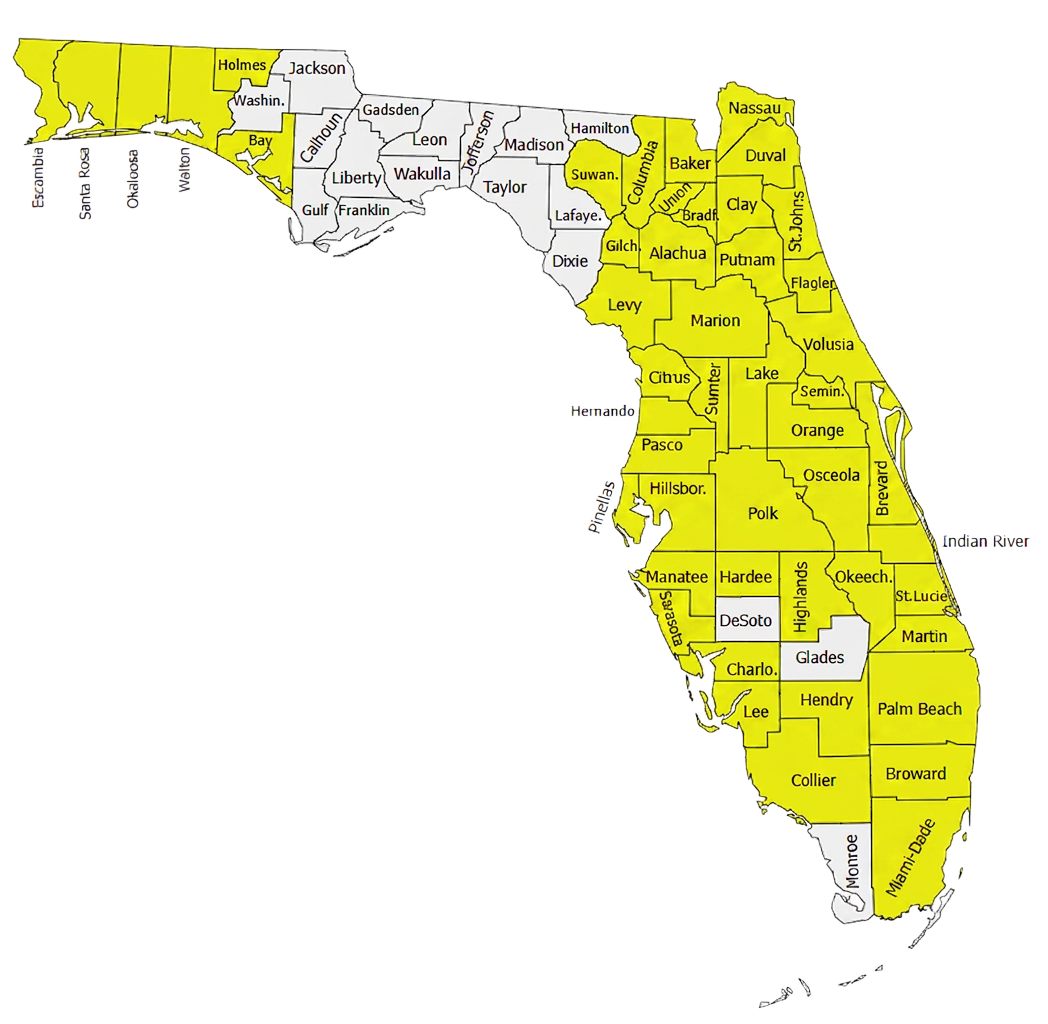
We treat post-surgical rehab across 50+ Florida counties. Pick a city to see local hospitals, crash corridors, and coverage notes for that market.
- Tampa, FLHillsborough County
- Wesley Chapel, FLPasco County
- Brandon, FLHillsborough County
- Clearwater, FLPinellas County
- St. Petersburg, FLPinellas County
- Lakeland, FLPolk County
- Orlando, FLOrange County
- Kissimmee, FLOsceola County
- Ocala, FLMarion County
- Spring Hill, FLHernando County
- Sarasota, FLSarasota County
- Bradenton, FLManatee County
- Riverview, FLHillsborough County
- Land O' Lakes, FLPasco County
- Palm Harbor, FLPinellas County
- New Port Richey, FLPasco County
- Trinity, FLPasco County
- Brooksville, FLHernando County
- Homosassa, FLCitrus County
- Hudson, FLPasco County
- Oldsmar, FLPinellas County
- Largo, FLPinellas County
- Plant City, FLHillsborough County
- Sun City Center, FLHillsborough County
- Parrish, FLManatee County
- Port Charlotte, FLCharlotte County
- Auburndale, FLPolk County
- The Villages, FLSumter County
- Wildwood, FLSumter County
- Leesburg, FLLake County
- Eustis, FLLake County
- Tavares, FLLake County
- Mount Dora, FLLake County
- Clermont, FLLake County
- Winter Garden, FLOrange County
- Apopka, FLOrange County
- Melbourne, FLBrevard County
- Daytona Beach, FLVolusia County
- Gainesville, FLAlachua County
- West Palm Beach, FLPalm Beach County
- Jupiter, FLPalm Beach County
- Fort Lauderdale, FLBroward County
- Pembroke Pines, FLBroward County
- Miami, FLMiami-Dade County
- Naples, FLCollier County
- Tallahassee, FLLeon County
- Pensacola, FLEscambia County
- Jacksonville, FLDuval County
- Fort Myers, FLLee County
- Cape Coral, FLLee County
Post-Surgical Rehab FAQ
- When does PT start after surgery?
- Usually within 1–7 days of discharge, depending on the procedure. The operating surgeon's protocol dictates the timing — some procedures begin PT in the hospital before discharge.
- Will my surgeon's protocol be followed exactly?
- Yes. Our DPTs work directly from the operating surgeon's written protocol and communicate progress back to the surgical team. If the protocol is non-standard, we contact the surgeon's office for clarification before progressing.
- Why is in-home PT a good fit after surgery?
- Driving is unsafe in the first 2–6 weeks after most orthopedic procedures (due to weight-bearing restrictions, sling use, or opioid use). In-home PT eliminates the transportation problem and reduces the risk of skipped visits during the most critical rehab window.
References & clinical evidence
All statistics on this page are sourced from peer-reviewed journals, clinical practice guidelines, or U.S. government health agencies.
- [1]AAOS — Annual Incidence of Common Musculoskeletal Procedures and Treatment— AAOS
- [2]Wound healing and tissue mechanics: implications for post-surgical rehabilitation— NIH / StatPearls, 2023
- [3]In-Home vs Outpatient Physical Therapy After Total Knee Arthroplasty — RCT— JAMA Internal Medicine, 2017
- [4]Inpatient versus outpatient rehabilitation after primary total knee arthroplasty — Cochrane review— Cochrane Database Syst Rev, 2018
- [5]Hip and Knee outcome measures (HOOS / KOOS) — validation— Health Qual Life Outcomes, 2003
- [6]Knee Pain and Mobility Impairments: Meniscal and Articular Cartilage Lesions — CPG— JOSPT / APTA, 2018
Related reading
Mobile Physical Therapy: The In-Home PT Guide for Florida Patients
How mobile, in-home physical therapy actually works in Florida — from referral and first visit to discharge — and when it's the right level of care.
What to Expect at Your First In-Home Physical Therapy Visit
A minute-by-minute breakdown of what happens at your first in-home physical therapy visit in Florida — what the therapist brings, how the evaluation works, and what you should have ready.
In-Home PT vs. Medicare Home Health: What's the Difference?
In-home physical therapy and Medicare home health both send a clinician to the patient's house, but they're regulated, billed, and clinically scoped very differently. After a Florida car accident, in-home PT is almost always the right fit — Medicare home health usually isn't an option at all.
Get a post-surgical rehab patient seen at home — usually within 48 hours.
Florida-licensed physical therapists covering 50+ counties in Florida.
Our clinicians reach major metros and rural communities alike — from the Panhandle to the Keys. Patients are typically seen at home or at their workplace within 48 hours of a complete referral.
- Clinicians on our team
- Statewide
- Florida counties covered
- 50+