
Why Auto-Accident Patients Skip PT — and How In-Home Care Fixes It
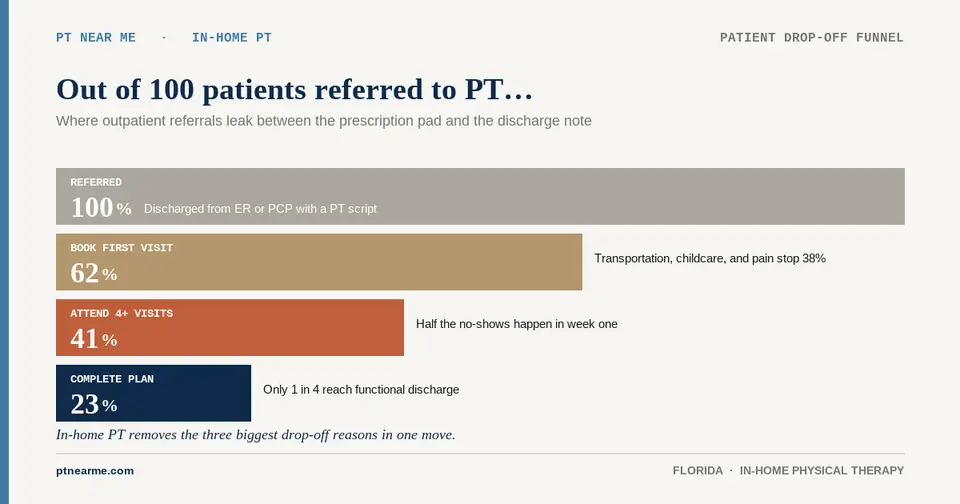
Roughly half of patients referred to outpatient physical therapy after a car accident never complete the prescribed plan of care. The reasons are mostly logistical, not medical — which is why moving treatment into the home dramatically improves attendance.
PT Near Me
Florida-licensed in-home physical therapy team
The short answer
Outpatient PT after an auto accident has a structurally low completion rate. Patients are referred at the worst moment of their recovery — when they're in the most pain, often without a working car, frequently on reduced income — and asked to drive themselves to three appointments a week for six to twelve weeks. Most don't finish, and the clinical record reflects that gap.
Why after a crash patients drop out of outpatient PT
When our intake team asks new referrals why prior outpatient PT didn't work, the answers cluster into a short list of logistical reasons:
- No reliable transportation after the crash, especially when the at-fault driver's insurer hasn't yet authorized a rental.
- Pain or fear about riding as a passenger, particularly in the first 4 weeks post-crash.
- Inability to take three afternoons off work for clinic visits without losing pay or childcare.
- Clinic locations that don't match where the patient actually lives — common in suburban and rural Florida.
- Waiting-room time that adds 30–60 minutes to every appointment.
Notice what's not on this list: disagreement with the plan of care, dissatisfaction with the therapist, or feeling 'recovered.' Patients overwhelmingly want to attend. They can't.
What changes when the therapist comes to the patient
| Barrier | Outpatient clinic | In-home PT |
|---|---|---|
| Transportation required | Yes — every visit | No |
| Waiting-room time | 20–60 minutes typical | None |
| Schedule flexibility | Clinic hours, mostly daytime | Mornings, evenings, weekends as needed |
| Bathroom / kitchen / stair assessment | Not possible | Built into every visit |
| Family / caregiver involvement | Limited | Direct |
Removing the commute also changes the clinical work itself. In-home visits let the therapist evaluate the actual surfaces, stairs, doorways, and bathrooms the patient navigates daily — and tailor the home exercise program to that environment instead of to a generic clinic gym.
What this means for recovery
Incomplete PT records correlate with worse functional outcomes — longer recovery, persistent pain, lower return-to-work rates. A complete treatment course — initial evaluation, consistent visits, measurable progress, discharge summary with residual deficits — is what gives the patient the best shot at returning to baseline.
Related articles
- Recovering After a Crash
How Soon Should You Start PT After a Car Accident in Florida?
In Florida, the practical answer is within 14 days — both because Florida law requires initial care in that window and because the clinical evidence strongly favors early intervention for soft-tissue and cervical-spine injuries.
PT Near Me · May 2, 2026
- In-Home PT
In-Home PT vs. Medicare Home Health: What's the Difference?
In-home physical therapy and Medicare home health both send a clinician to the patient's house, but they're regulated, billed, and clinically scoped very differently. After a Florida car accident, in-home PT is almost always the right fit — Medicare home health usually isn't an option at all.
PT Near Me · June 22, 2026
- In-Home PT
The Cost of In-Home Physical Therapy in Florida: Auto Insurance, Cash, and What You Actually Pay
What in-home physical therapy actually costs Florida patients across auto insurance, Medicare, and cash-pay — with realistic out-of-pocket ranges and the rules that decide which one applies to your case.
PT Near Me · June 23, 2026
In your city
Conditions we treat across Florida
Each guide below covers the clinical evidence, recovery timelines, and coverage details specific to these conditions.
Don’t see your city? View all Florida service areas.
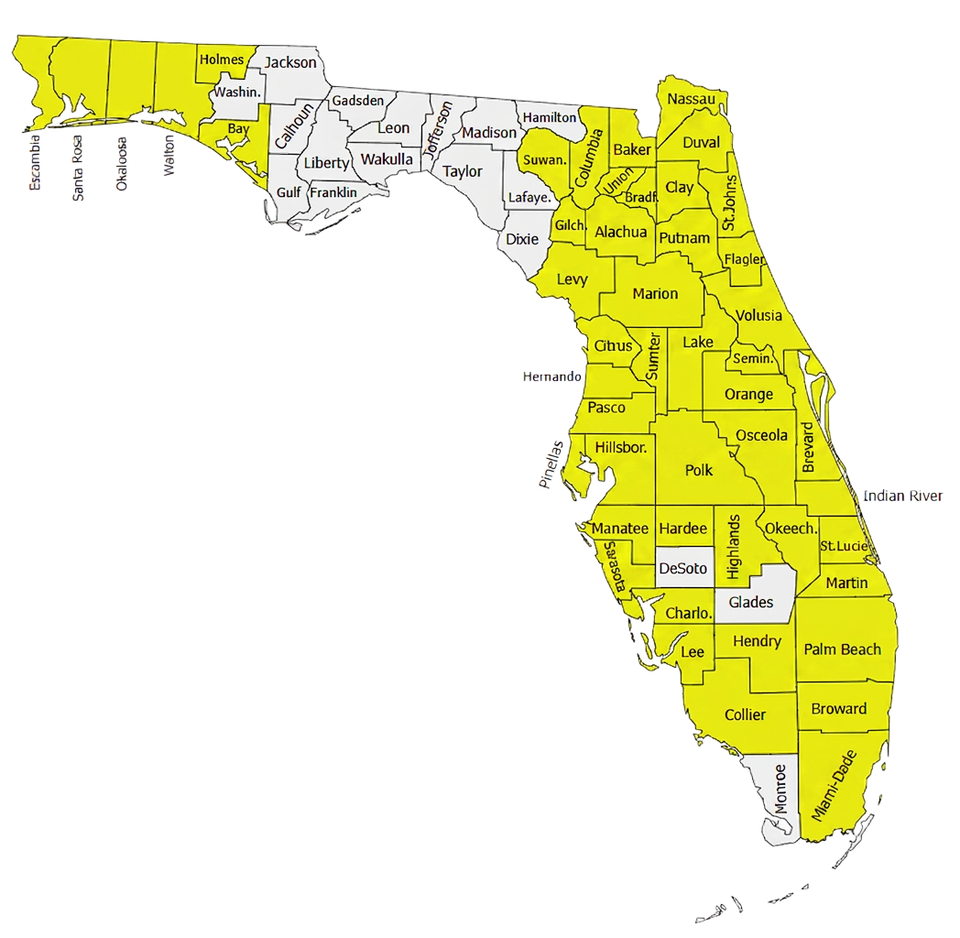
Florida-licensed physical therapists covering 50+ counties in Florida.
Our clinicians reach major metros and rural communities alike — from the Panhandle to the Keys. Patients are typically seen at home or at their workplace within 48 hours of a complete referral.
- Clinicians on our team
- Statewide
- Florida counties covered
- 50+
Need to refer a Florida patient?
Our intake team confirms auto insurance coverage during the call and schedules most patients at home or at their workplace within 48 hours.