
Physical Therapy Abbreviations and Terminology: A Plain-English Glossary
PT stands for physical therapy (or physical therapist). This glossary defines the abbreviations and movement terms on your chart and home exercise program — WBAT, HEP, AROM, PROM, BLE, S/P, OOB and more.
PT Near Me
Florida-licensed in-home physical therapy team
Why physical therapy terminology matters for patients
Physical therapy comes with a vocabulary. The first time you read a plan of care or a home exercise program, you will see words like flexion, abduction, AROM, PROM, WBAT, and SOAP. None of those are meant to confuse you — they are clinical shorthand that lets your therapist, your referring physician, and your insurer talk about the same thing without ambiguity. The problem is that nobody hands you a translation key on day one.
When you understand the language, three things change. You stop guessing whether an exercise is being done correctly. You ask sharper questions during your visit. And you spot mistakes — like a home program that says "perform 3 sets of AAROM shoulder flexion to 120°" when your surgeon's protocol says you should still be in passive range only. Patients who understand the words tend to have better outcomes because they catch problems early and stick to the plan more consistently.
This guide walks through the terminology in the order you are most likely to encounter it: movement and position words first, then strength and exercise terms, then surgical and weight-bearing language, then the abbreviations you will see scribbled on every chart. By the end, you should be able to read a typical PT note and a home exercise program without a dictionary.
What does PT stand for?
PT is the abbreviation for physical therapy — the treatment — and also for physical therapist, the licensed clinician who provides it. In a chart, context tells you which one is meant: "pt tolerated PT well" uses a lowercase pt for patient and an uppercase PT for the therapy session. Outside of rehab notes, PT can also mean prothrombin time on a lab report, so read it in the setting it appears in.
| Abbreviation | Stands for | What it means |
|---|---|---|
| PT | Physical therapy / physical therapist | The treatment, or the licensed clinician who evaluates you and writes the plan of care. |
| DPT | Doctor of Physical Therapy | The entry-level clinical doctorate physical therapists earn today. A DPT is a physical therapist, not a physician. |
| MPT / MSPT | Master of Physical Therapy | An earlier PT degree. Clinicians who hold it are licensed physical therapists. |
| PTA | Physical therapist assistant | A licensed clinician who delivers treatment under a physical therapist's plan of care. |
| SPT | Student physical therapist | A PT student on clinical rotation, supervised by a licensed therapist. |
| OT / OTA | Occupational therapy / occupational therapy assistant | Therapy focused on daily tasks — dressing, bathing, cooking, work duties — rather than on gait and gross movement. |
| SLP | Speech-language pathologist | Treats speech, language, cognition, and swallowing. |
The short version: PT works on movement, strength, balance, and walking. OT works on the tasks of daily life. Many patients after a crash or a surgery see both.
Movement and position words
Most of physical therapy is about how a joint moves and how a body is oriented in space. These are the building blocks for every exercise instruction.
Range of motion (ROM)
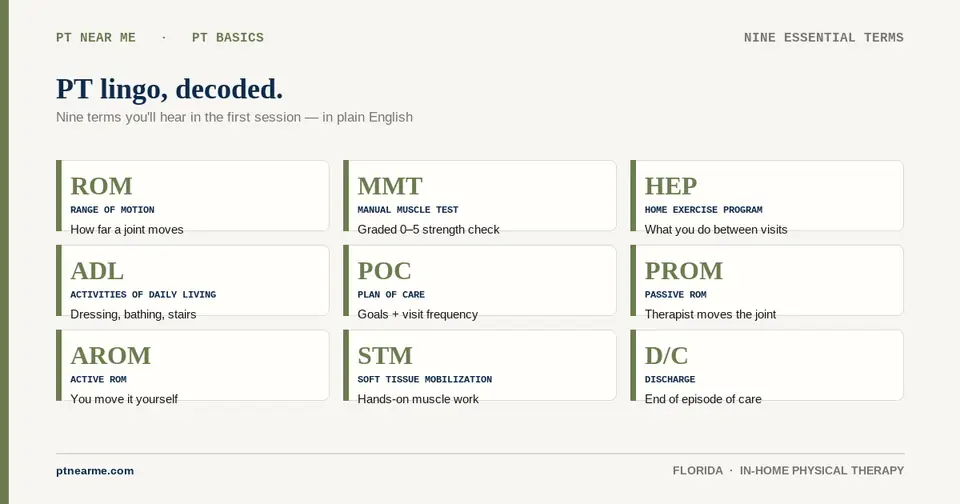
Range of motion is the total amount a joint can move through, usually measured in degrees with a goniometer. Therapists track ROM at the first visit and at intervals throughout care to show whether the joint is loosening up. You will see three flavors: active range of motion (AROM), where you move the joint yourself; passive range of motion (PROM), where the therapist moves it for you; and active-assisted range of motion (AAROM), where you start the motion and the therapist or a strap finishes it.
Flexion, extension, abduction, adduction
Flexion is bending a joint to close the angle — bending your elbow to touch your shoulder, for example. Extension is the opposite: straightening the joint to open the angle. Abduction is moving a limb away from the midline of your body (lifting your arm out to the side), and adduction is bringing it back toward the midline.
Internal and external rotation
Internal rotation turns a limb toward the centerline of your body — think of turning your forearm so your palm faces the floor. External rotation turns it the other way. Shoulder and hip rotation are common targets after rotator cuff repair, total hip replacement, and shoulder dislocation.
Supine, prone, sidelying, quadruped
These describe the position your body is in during an exercise. Supine is on your back. Prone is on your stomach. Sidelying is on your side. Quadruped is on hands and knees. Each position changes which muscles do the work and which joints are loaded, which is why a home exercise sheet will be specific about which one to use.
| Term | Plain-language meaning |
|---|---|
| ROM | How far a joint can move |
| AROM / PROM / AAROM | Active / passive / active-assisted range of motion |
| Flexion | Bending a joint to close the angle |
| Extension | Straightening a joint to open the angle |
| Abduction | Moving a limb away from the midline |
| Adduction | Moving a limb toward the midline |
| Internal rotation | Rotating a limb toward the body's center |
| External rotation | Rotating a limb away from the body's center |
| Supine | Lying face-up |
| Prone | Lying face-down |
Strength, flexibility, and exercise terms
Isometric, concentric, eccentric
These describe what the muscle is doing during an exercise. Isometric means the muscle generates force without changing length — pushing your palm into a wall, for example. Concentric means the muscle shortens under load, like the upward phase of a bicep curl. Eccentric means the muscle lengthens under load, like slowly lowering that same dumbbell. Eccentric work is especially important after tendon injuries because controlled lengthening reloads the tendon in a way that drives healing.
Progressive overload
Progressive overload is the principle that to keep getting stronger, you have to gradually increase the demand on the muscle — more weight, more reps, more sets, less rest, or a harder variation of the exercise. Your home program should change every two to three weeks for exactly this reason. If it doesn't, you've plateaued.
Proprioception and balance
Proprioception is your body's sense of where it is in space — the reason you can touch your nose with your eyes closed. After an ankle sprain, an ACL reconstruction, or a fall, proprioception is impaired. Balance exercises (single-leg stance, foam-pad work, perturbations) retrain it. Without that retraining, you re-injure the same joint.
Post-surgical terminology and weight-bearing status
If you've had surgery — orthopedic, spinal, or otherwise — your discharge paperwork will include precautions. Misreading them is one of the most common ways people compromise their recovery.
Weight-bearing status
Your surgeon sets how much weight you can put on the operated limb. Non-weight-bearing (NWB) means no weight at all — the foot doesn't touch the floor. Toe-touch weight-bearing (TTWB) lets you rest the foot for balance but bear no weight. Partial weight-bearing (PWB) is usually expressed as a percentage of body weight. Weight-bearing as tolerated (WBAT) means as much as is comfortable without sharp pain. Full weight-bearing (FWB) means no restrictions.
Surgical precautions
These are surgeon-prescribed motions to avoid. Posterior-approach total hip replacement patients, for example, are usually told not to flex past 90°, cross the midline, or internally rotate the hip for the first six to eight weeks. A good in-home therapist confirms the precautions with your surgeon's office before starting and rebuilds the home setup (chair height, toilet riser, sleeping position) around them.
Rehab protocol
A protocol is the surgeon's timeline of what's allowed at each milestone — when ROM can progress, when strengthening can begin, when running or return to sport is permitted. Protocols vary by surgeon and procedure, so the right document is the one your surgeon wrote, not a generic one off the internet.
Physical therapy abbreviations, grouped by what they describe
Therapists shorthand almost everything to save time. These are the abbreviations you'll see on a home exercise program, a progress note, a hospital discharge summary, or an evaluation you read at the front desk. They're grouped by what they describe so you can find the one you're looking at.
General chart shorthand
| Abbreviation | Meaning |
|---|---|
| Pt / pt | Patient (lowercase). Uppercase PT usually means physical therapy or physical therapist. |
| Dx | Diagnosis |
| Tx | Treatment |
| Hx | History |
| H/O | History of — as in "H/O low back pain," meaning the patient has had it before |
| S/P | Status post — meaning after. "S/P R TKA" means after a right total knee replacement. |
| c/o | Complains of |
| SOAP | Subjective, Objective, Assessment, Plan — the standard note format |
| Eval / Re-eval | Initial evaluation / follow-up re-assessment |
| POC | Plan of care — the therapist's written treatment plan and goals |
| D/C or DC | Discharge (from therapy, or from the hospital) |
| NAD | No acute distress |
| WNL | Within normal limits |
| WFL | Within functional limits — not textbook-normal, but enough for daily tasks |
| PRN | As needed |
| BID / TID / QD | Twice a day / three times a day / once a day |
| x/wk | Times per week, as in "PT 2x/wk x 6 wks" |
Body regions and sides
| Abbreviation | Meaning |
|---|---|
| LE / UE | Lower extremity (leg) / upper extremity (arm) |
| BLE / BUE | Bilateral lower extremities (both legs) / bilateral upper extremities (both arms) |
| LLE / RLE | Left lower extremity / right lower extremity |
| LUE / RUE | Left upper extremity / right upper extremity |
| R / L / B | Right / left / bilateral (both sides) |
| C-spine / T-spine / L-spine | Cervical (neck), thoracic (mid-back), lumbar (low back) spine |
| UT | Upper trapezius — the muscle across the top of the shoulder and neck |
| MM | Muscle. "MM spasm" means muscle spasm. |
| Jt | Joint |
Movement, strength, and mobility
| Abbreviation | Meaning |
|---|---|
| ROM | Range of motion — how far a joint moves |
| AROM / PROM / AAROM | Active (you move it) / passive (someone moves it for you) / active-assisted range of motion |
| MMT | Manual muscle test, graded 0–5 |
| PIVM | Passive intervertebral motion — a hands-on test of how much one spinal segment moves |
| OOB | Out of bed |
| Amb | Ambulate — to walk |
| Gait trng | Gait training — practicing walking mechanics |
| Transfers | Moving between surfaces: bed to chair, chair to car, sit to stand |
| ADL / IADL | Activities of daily living (dressing, bathing) / instrumental ADLs (cooking, driving, managing money) |
| FWW / RW | Front-wheeled walker / rolling walker |
| SPC | Single-point cane |
| w/c | Wheelchair |
| DME | Durable medical equipment — walkers, canes, wheelchairs, braces |
How much help you need (assistance levels)
| Abbreviation | Meaning |
|---|---|
| Indep / I | Independent — no help needed |
| Mod I | Modified independent — no hands-on help, but needs extra time or a device |
| SBA | Stand-by assist — someone stands close in case, but doesn't touch you |
| CGA | Contact-guard assist — a hand on you for safety, no lifting |
| Min A / Mod A / Max A | Minimal, moderate, or maximal hands-on assistance |
| Total A | Total assistance — the helper does essentially all the work |
| VC / TC | Verbal cues / tactile cues — prompts the therapist gives during a task |
Weight-bearing and surgery
| Abbreviation | Meaning |
|---|---|
| WBAT | Weight-bearing as tolerated — put as much weight on the limb as is comfortable |
| NWB | Non-weight-bearing — no weight on the limb at all |
| PWB | Partial weight-bearing — a limited percentage, set by the surgeon |
| TTWB / TDWB | Toe-touch or touch-down weight-bearing — foot rests on the floor for balance only |
| FWB | Full weight-bearing — no restriction |
| THA / THR | Total hip arthroplasty / total hip replacement |
| TKA / TKR | Total knee arthroplasty / total knee replacement |
| TSA | Total shoulder arthroplasty |
| ACLR | ACL reconstruction |
| ORIF | Open reduction internal fixation — a fracture repaired with plates or screws |
| Fx | Fracture |
Treatments and billed interventions
| Abbreviation | Meaning |
|---|---|
| HEP | Home exercise program — the exercises you do between visits |
| TheraEx / Ther Ex | Therapeutic exercise |
| Ther Act | Therapeutic activity — task-based training like lifting, carrying, or stairs |
| NMR / NMRE | Neuromuscular re-education — retraining balance, coordination, and control |
| Manual / MT | Manual therapy — hands-on joint and soft-tissue work |
| e-stim / ES | Electrical stimulation |
| TENS | Transcutaneous electrical nerve stimulation, used for pain |
| US | Therapeutic ultrasound |
| MHP / CP | Moist heat pack / cold pack |
| NPRS / VAS | Numeric pain rating scale / visual analog scale |
Settings and levels of care
| Abbreviation | Meaning |
|---|---|
| OP | Outpatient — therapy at a clinic you travel to |
| IP | Inpatient — therapy during a hospital stay |
| HH / HHA | Home health / home health agency — skilled care delivered at home |
| SNF | Skilled nursing facility |
| IRF | Inpatient rehabilitation facility |
| MVA / MVC | Motor vehicle accident / motor vehicle collision |
If you see one that isn't on this list and your therapist hasn't explained it, ask. A note or home program that the patient can't read is one of the easiest fixes in healthcare — and a sign the therapist is rushing.
Pain and symptom language you'll be asked to use
Your therapist will ask about pain in specific ways because vague pain reports lead to vague plans. The more precise you are, the better the plan. Three scales come up constantly.
Numeric Pain Rating Scale (NPRS)
Rate your pain 0 to 10, where 0 is no pain and 10 is the worst pain imaginable. You'll be asked to rate pain at rest, with specific movements, and at its worst over the past 24 hours. Tracking these three numbers session to session is one of the clearest signs of whether the plan is working.
Visual Analog Scale (VAS)
Same idea as NPRS, but you mark a point on a 100 mm line instead of choosing a whole number. VAS is more sensitive to small changes — useful in research and in cases where a half-point shift matters.
Quality-of-pain descriptors
Sharp, dull, achy, burning, throbbing, electric, deep, superficial — the quality matters because it points at the tissue. Burning and electric pain hints at nerve involvement; achy, dull, deep pain usually points at muscle or joint structures. Be specific even if it feels odd; therapists are trained to listen for these descriptors.
Functional limitations
More important than any pain number: what can you not do that you used to do? Sit at your desk for more than 20 minutes? Sleep on your right side? Lift your toddler? Reach the top shelf? Functional limitations are what goals are built on, and they're what progress is measured against.
How PT Near Me handles terminology with patients
We bill the patient's auto insurance for crash-related care. We do not bill regular health insurance or Medicare. If terminology on a referral, discharge summary, or surgical protocol isn't clear, our intake team confirms with the referring office before the first visit — so the first session isn't spent guessing.
We also bring the terminology into the patient's actual environment. Reading "WBAT with rolling walker, lead with right LE ascending" on a post-op discharge sheet is one thing. Practicing it on your real stairs with your real walker, in your real shoes, with your real shoulder bag in the other hand, is what makes the language click. That's the difference between a printout the patient never reads and a plan the patient actually uses.
Related reading
Frequently asked questions
- Do I need to memorize all these terms before my first visit?
- No. A good therapist will explain anything you don't understand the first time it comes up. This guide is here so you have a reference if you want one — not a quiz.
- What's the difference between AROM and PROM?
- AROM (active range of motion) means you move the joint yourself using your own muscles. PROM (passive range of motion) means the therapist moves it for you while your muscles stay relaxed. Early after surgery, PROM is often the only thing allowed; AROM is added as healing progresses.
- My home program says WBAT. What does that mean for going up stairs?
- Weight-bearing as tolerated means you can put as much weight on the operated leg as is comfortable without sharp pain. Use a railing, lead with the non-operated leg going up, and lead with the operated leg coming down. Your therapist should walk you through this in person.
- Why do therapists use abbreviations on my chart?
- Speed and consistency. SOAP notes and abbreviations are an industry standard that lets any therapist or physician picking up your chart understand exactly what was done, in what dose, and how you responded — without ambiguity.
- What is the abbreviation for physical therapy?
- PT. The same two letters are also the abbreviation for physical therapist, and DPT means Doctor of Physical Therapy — the clinical doctorate therapists earn today. In a chart, a lowercase pt usually means patient.
- What does S/P mean in a physical therapy note?
- S/P means status post, which simply means after. "S/P L THA" means after a left total hip replacement. It tells the reader what event the current plan of care follows.
- What does BLE mean?
- BLE means bilateral lower extremities — both legs. BUE is both arms, LLE is the left leg, and RUE is the right arm.
- What does HEP mean on my paperwork?
- HEP is your home exercise program: the exercises you perform between visits. It should list each exercise with sets, reps, how often, and ideally a photo or short video.
- What does OOB mean?
- OOB means out of bed. In a note it usually describes how much help you needed to get out of bed, or how much time you spent out of bed that day.
- What is the difference between PT and OT?
- Physical therapy works on movement, strength, balance, and walking. Occupational therapy works on the tasks of daily life — dressing, bathing, cooking, and returning to work duties. Many patients recovering from a crash or surgery see both.
Related articles
- PT Basics & Glossary
The Ultimate Physical Therapy Cheat Sheet for Patients and Clinicians
A practical reference for how good PT works: evaluation, SOAP notes, SMART goals, common treatments, and the documentation patients have every right to ask for.
PT Near Me · June 22, 2026
- PT Basics & Glossary
Physical Therapist vs. PTA: Roles, Education, and Differences
PTs and PTAs both treat patients, but they aren't interchangeable. A clear look at scope, education, and what each role does during your care.
PT Near Me · June 22, 2026
- PT Basics & Glossary
Sciatica Stretches That Actually Work: A PT's Guide
Sciatica pain almost always calms down faster with the right stretches done in the right order — nerve glides first, then hip and low-back mobility, then core stability. Here is the safe, step-by-step routine a physical therapist would give you at a first visit.
PT Near Me · July 1, 2026
In your city
Conditions we treat across Florida
Each guide below covers the clinical evidence, recovery timelines, and coverage details specific to these conditions.
Don’t see your city? View all Florida service areas.
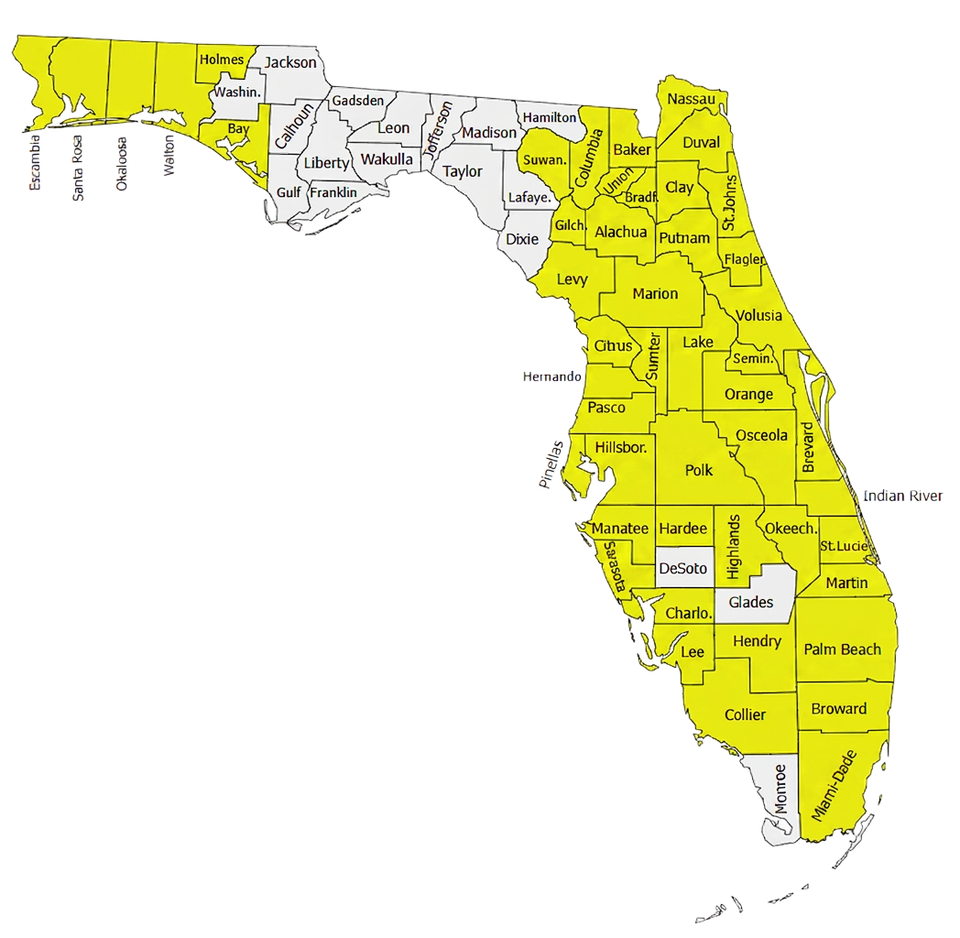
Florida-licensed physical therapists covering 50+ counties in Florida.
Our clinicians reach major metros and rural communities alike — from the Panhandle to the Keys. Patients are typically seen at home or at their workplace within 48 hours of a complete referral.
- Clinicians on our team
- Statewide
- Florida counties covered
- 50+
Need to refer a Florida patient?
Our intake team confirms auto insurance coverage during the call and schedules most patients at home or at their workplace within 48 hours.