
In-Home Physical Therapy for Elderly Parents in Florida: A Family Caregiver's Guide
How to arrange, fund, and evaluate in-home physical therapy for an aging parent in Florida — covering hospital discharge, fall recovery, Medicare vs. Medicare home health, and what to look for in a clinician.
PT Near Me
Florida-licensed in-home physical therapy team
The first 30 days at home matter more than most families realize
When an aging parent comes home from the hospital after a fall, a surgery, or a serious illness, the next 30 days largely decide what their next year of function looks like. Strength is lost quickly in older adults — a Johns Hopkins study found that hospitalized older adults can lose more than 10% of leg strength in a single week of bed rest. Once strength and confidence drop, the risk of a second fall climbs sharply, and the cycle of decline accelerates.
Physical therapy in that first month is the highest-leverage intervention available. The challenge is logistical: most newly discharged older adults can't drive, can't reliably get a ride three times a week, and can't sit in a clinic waiting room for an hour. In-home PT solves that — the clinician comes to them, evaluates them in the environment they actually live in, and trains the exact transfers they need to make every day.
In-home PT vs. Medicare home health — what's the difference?
This is the question that confuses almost every family caregiver. They aren't the same thing.
| Criterion | In-home PT (PT Near Me) | Medicare home health |
|---|---|---|
| Homebound required? | No | Yes — strict CMS rule |
| Who pays | Auto insurance or cash | Medicare Part A |
| Referral source | Any MD or self-refer | MD certification + plan of care |
| Visit length | 55–60 minutes | 30–45 minutes |
| Frequency | 2–3x/week typical | 1–3x/week typical |
| Best for | Active recovery, after a crash | Homebound, post-op or chronic decline |
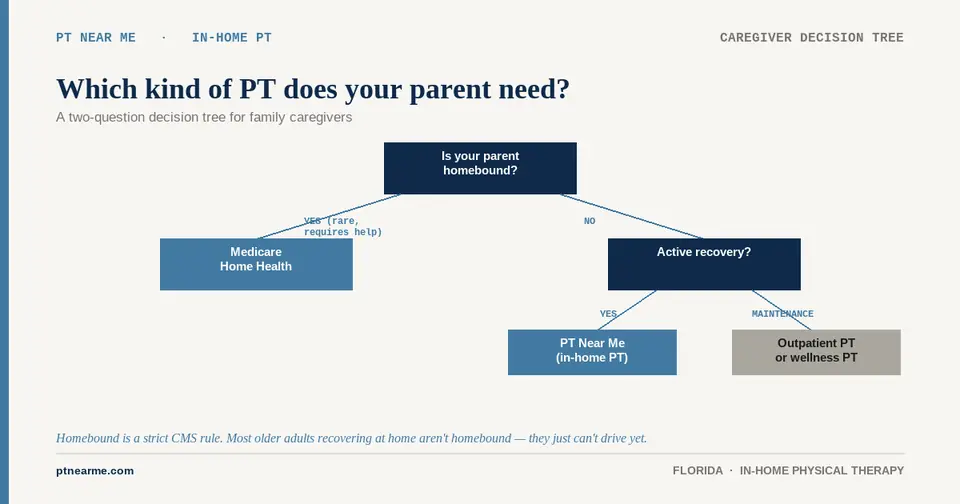
The full breakdown is in the In-Home PT vs. Medicare Home Health guide. The short version: if your parent is genuinely homebound (leaving home is a major effort, requires assistance, and is rare), Medicare home health is the right path and your discharge planner will set it up. If your parent can leave the house but shouldn't be driving themselves to a clinic three times a week, in-home PT is the right path — and you can arrange it directly.
The four scenarios we see most often
- Post-fall recovery. Parent fell, was treated at an ER or admitted briefly, came home without a fracture. PT is the rebuilding work — balance, strength, gait, confidence.
- Post-surgical recovery. Hip or knee replacement, rotator cuff repair, spine surgery. The first 4–6 weeks at home are the highest-leverage window for recovery.
- Post-hospitalization deconditioning. Parent was in the hospital for something non-orthopedic (pneumonia, sepsis, cardiac event) and came home weaker than they went in. PT rebuilds function.
- Motor vehicle accident. Parent was in a car accident and is dealing with soft-tissue or orthopedic injuries. Auto insurance funds the care when it begins within Florida's 14-day window.
What a good in-home PT evaluation looks like for an elderly parent
An evaluation for an older adult should look different from an evaluation for a 30-year-old after a crash patient. The clinician should be assessing the whole picture, not just the body part that's hurting.
- Home safety assessment: rug edges, stairs, bathroom layout, bed height, lighting, grab bars, the chair your parent actually sits in for hours.
- Balance and fall risk: standardized tests like the Berg Balance Scale or Timed Up and Go, not just "do they look steady?"
- Functional ADLs: can your parent get in and out of bed, on and off the toilet, in and out of the shower, up and down stairs?
- Medication review: not because the PT prescribes meds, but because some medication combinations increase fall risk and should be flagged to the prescribing MD.
- Cognitive baseline: brief screening so the home program can be tailored to what your parent can actually remember and execute.
- Caregiver training: if you're going to be helping with transfers or the home program, the clinician should be teaching you, not just your parent.
Questions to ask before the first visit
- Is the clinician a licensed Doctor of Physical Therapy or a PT assistant? (Both can deliver care; only a DPT can evaluate and write the plan of care.)
- Will the same clinician see my parent every visit?
- What's the cadence — how many visits per week and for how long?
- How does communication with my parent's primary care doctor work?
- What happens if my parent gets readmitted to the hospital mid-treatment?
- How is the home program written and updated?
- What's the billing arrangement and what should I expect to pay out of pocket?
We answer all of these on the intake call. The cost guide covers the financial side in detail.
Red flags that warrant a same-day call to the doctor
- A new fall, especially with any head impact, even if your parent says they're fine.
- New confusion or sudden change in mental status.
- Sudden onset of significant new pain, weakness, or numbness on one side of the body.
- Chest pain, shortness of breath, or unexplained dizziness.
- A surgical wound that becomes red, hot, or starts draining.
The PT clinician will flag any of these to the referring physician — but as a family caregiver, you don't need to wait for that. Call the doctor directly, and call 911 for anything that looks like a stroke, a cardiac event, or a serious injury.
Where we serve Florida families
PT Near Me clinicians live in or near the cities they serve. For families whose parents are recovering at home in any of the cities below, in-home PT is available within 48 hours of the call.
Related guides and trusted sources
Frequently asked questions
- Can I set this up for my parent without a doctor's order?
- Yes for an evaluation — Florida allows direct access to PT. For ongoing care funded by auto insurance or auto liability we coordinate with the treating physician. For Medicare-funded care, a physician order is required.
- What if my parent has dementia?
- We treat patients with cognitive impairment regularly. The plan of care is adapted — simpler home program, more caregiver involvement, more emphasis on environmental setup and safety than on independent exercise.
- Does PT Near Me bill Medicare?
- Sometimes — Medicare Part B outpatient PT can be billed for certain cases. Medicare home health is a separate program. Tell intake your parent's coverage and we'll route appropriately.
- What if my parent lives in assisted living?
- We treat patients in assisted living and independent living communities across Florida regularly. The room your parent lives in is the treatment space.
- My parent fell last week and is afraid to walk. Is PT the right call?
- Yes — fear of falling is itself a fall risk factor, and graded exposure under a PT's supervision is the evidence-based intervention. Don't wait for a second fall to call.
- I live out of state. Can I arrange this for my parent?
- Yes. Family caregivers regularly call us from out of state. We coordinate scheduling and reporting with whichever local family member or care manager is on the ground.
- Can the therapist train me on how to help safely?
- Yes — and this is one of the most valuable parts of in-home PT for family caregivers. Transfer training, fall recovery training, and home program coaching are part of the workflow.
Related articles
- In-Home PT
In-Home PT vs. Medicare Home Health: What's the Difference?
In-home physical therapy and Medicare home health both send a clinician to the patient's house, but they're regulated, billed, and clinically scoped very differently. After a Florida car accident, in-home PT is almost always the right fit — Medicare home health usually isn't an option at all.
PT Near Me · June 22, 2026
- In-Home PT
Why Auto-Accident Patients Skip PT — and How In-Home Care Fixes It
Roughly half of patients referred to outpatient physical therapy after a car accident never complete the prescribed plan of care. The reasons are mostly logistical, not medical — which is why moving treatment into the home dramatically improves attendance.
PT Near Me · April 8, 2026
- In-Home PT
The Cost of In-Home Physical Therapy in Florida: Auto Insurance, Cash, and What You Actually Pay
What in-home physical therapy actually costs Florida patients across auto insurance, Medicare, and cash-pay — with realistic out-of-pocket ranges and the rules that decide which one applies to your case.
PT Near Me · June 23, 2026
In your city
Conditions we treat across Florida
Each guide below covers the clinical evidence, recovery timelines, and coverage details specific to these conditions.
Don’t see your city? View all Florida service areas.
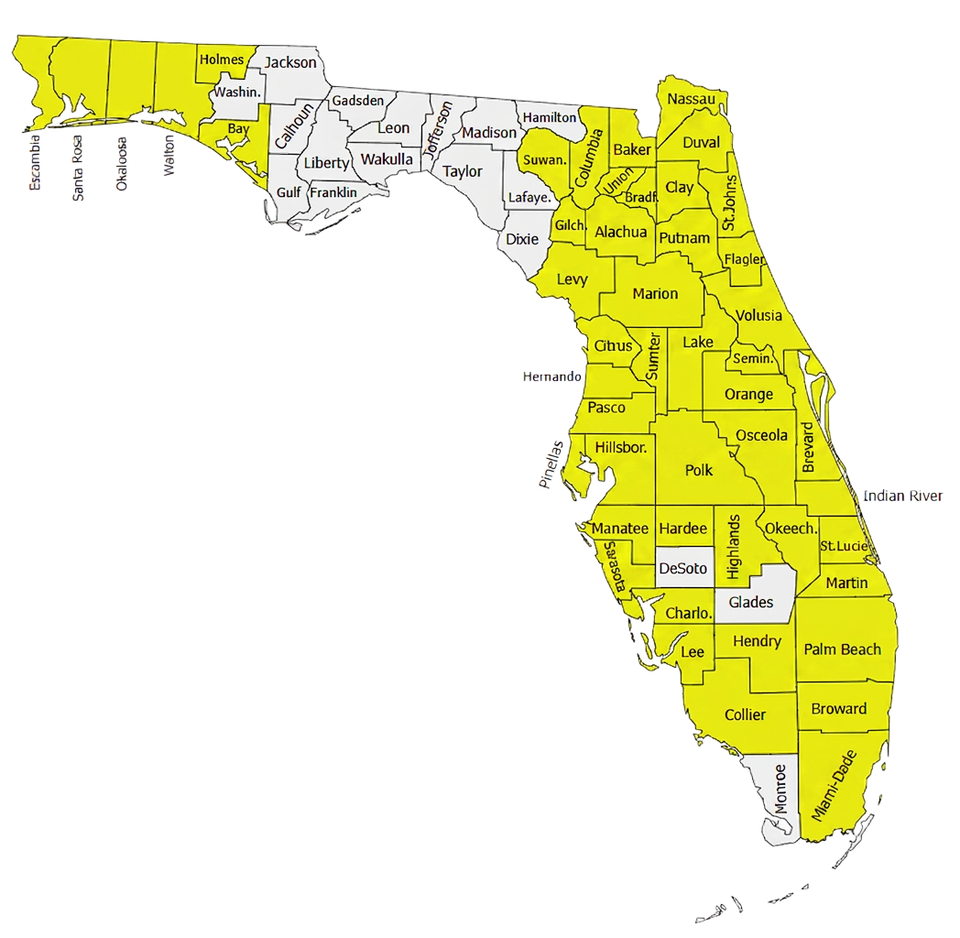
Florida-licensed physical therapists covering 50+ counties in Florida.
Our clinicians reach major metros and rural communities alike — from the Panhandle to the Keys. Patients are typically seen at home or at their workplace within 48 hours of a complete referral.
- Clinicians on our team
- Statewide
- Florida counties covered
- 50+
Need to refer a Florida patient?
Our intake team confirms auto insurance coverage during the call and schedules most patients at home or at their workplace within 48 hours.