
Hip Pain After a Car Accident: Causes & Treatment
Hip pain after a Florida car accident is usually the result of dashboard impact, seatbelt loading, or twisting forces — and most cases respond well to early, structured physical therapy. Here is what causes it, what the red flags are, and how auto insurance pays for in-home PT.
PT Near Me
Florida-licensed in-home physical therapy team
Why the hip gets hurt in a car crash
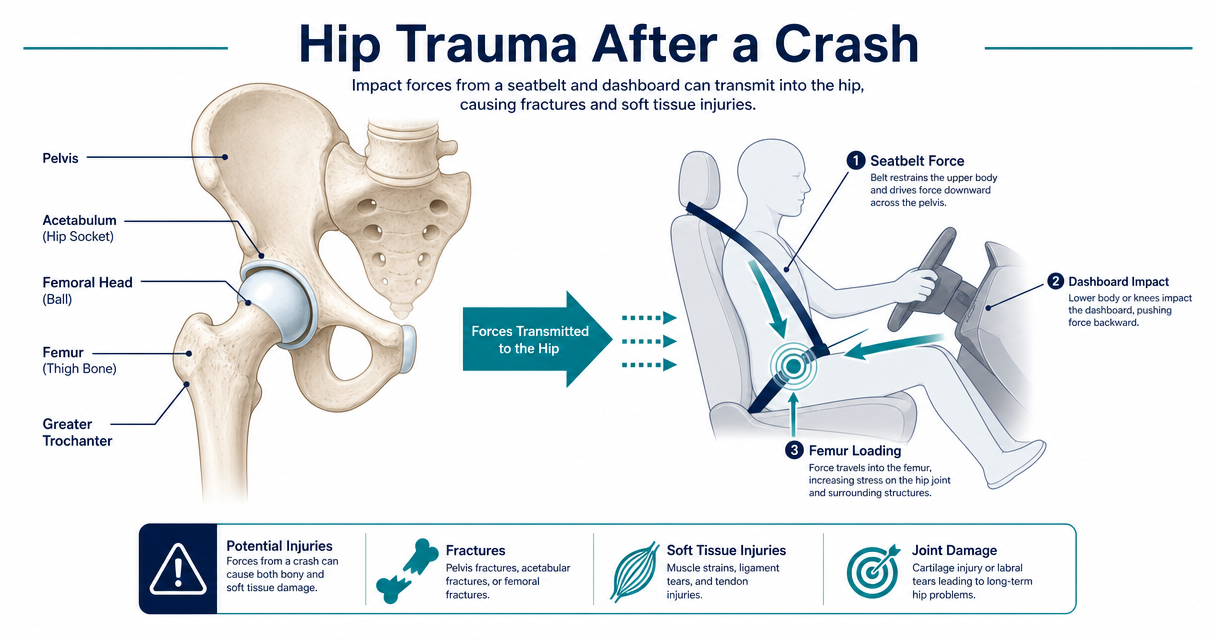
The hip joint takes load from two directions during a crash. The seatbelt restrains the pelvis and torso while the legs continue forward, driving the femur backward into the acetabulum (the socket). At the same time the knees often strike the dashboard or steering column, and that force travels up the femur into the same joint. The result is a wide range of possible injuries — bony, cartilaginous, or soft-tissue — that all show up clinically as 'hip pain.'
According to the CDC, motor vehicle crashes remain a leading cause of non-fatal injury in the United States, with extremity and pelvic injuries common even at moderate speeds. The hip is anatomically vulnerable because it sits at the intersection of those crash-force vectors.
What 'hip pain after a crash' actually is
Five injury patterns account for the large majority of after a crash hip referrals we see across Florida:
| Diagnosis | How it happens | Typical symptoms |
|---|---|---|
| Acetabular labral tear | Femoral head jammed into the socket on impact | Deep groin pain, catching or clicking, pain with prolonged sitting |
| Trochanteric bursitis | Lateral hip struck by door or armrest; gait compensation post-crash | Pain over the outer hip, worse lying on that side at night |
| Hip-flexor / adductor strain | Sudden bracing of the leg against the floorboard | Groin or anterior thigh pain, pain with stairs and getting in/out of a car |
| Femoral or acetabular fracture | High-energy dashboard impact | Severe pain, inability to bear weight, deformity — ER-level injury |
| SI joint dysfunction | Asymmetric pelvic loading from a side or rear impact | One-sided low back / buttock pain, worse with rolling in bed |
These overlap. A patient with a labral tear often also has hip-flexor guarding, and a patient with bursitis often has compensatory low-back pain. The first job of the physical therapy evaluation is to sort the primary driver from the downstream compensations — see what happens at the first in-home PT visit.
Red flags — when to go to the ER first
Most after a crash hip pain is musculoskeletal and safe to evaluate in-home, but a small subset needs imaging before any PT. Take the patient to the emergency department or call EMS if any of the following are present:
- Inability to bear any weight on the leg.
- Visible deformity or the leg appearing shortened or rotated.
- Numbness, tingling, or weakness running down the leg.
- Loss of bowel or bladder control.
- Severe escalating pain at rest, fever, or signs of internal injury (abdominal pain, dizziness, fainting).
Why early physical therapy matters
Two weeks of guarding a painful hip changes the way the patient walks, sits, sleeps, and bends — and those compensations stick. Patients who wait two months to start PT routinely arrive with a stiff joint, weakened gluteal muscles, a shifted gait pattern, and a new layer of low-back pain that was not present at the crash. The original injury has often healed; the compensations now drive the symptoms.
Early active rehabilitation — within the first 1–2 weeks when safe — is well supported by orthopedic literature for soft-tissue and post-traumatic joint injuries. The PT evaluation establishes a movement baseline, the plan of care progresses load tolerance from passive to active to functional, and the home exercise program keeps the hip moving between visits. See how soon to start PT after a Florida car accident for the timing framework.
What in-home PT for a after a crash hip actually looks like
A typical episode of care for a non-surgical after a crash hip injury runs 2–3 visits per week for 6–12 weeks. Each in-home session blends:
- Manual therapy — joint mobilization, soft-tissue work to the hip flexors, glutes, and lumbar paraspinals.
- Range-of-motion progressions, starting passive and moving to active assisted and active.
- Strengthening — open- and closed-chain glute, hip-abductor, and core work, progressed with bands and bodyweight in the home environment.
- Functional retraining — getting in and out of a car, climbing the patient's actual stairs, sit-to-stand from the patient's actual couch.
- A written home exercise program with photos or short videos the patient can repeat on non-visit days.
Doing this work in the patient's home — instead of a clinic gym — matters more for the hip than for almost any other joint. Patients struggle to drive after a hip injury, sitting through a clinic commute aggravates the symptom most, and the actual obstacles that limit function (the threshold into the kitchen, the height of the bed, the depth of the couch) only exist at home.
Realistic recovery timeline
| Phase | Weeks | Goals |
|---|---|---|
| Acute / protective | 0–2 weeks | Pain control, swelling management, gentle ROM, gait safety |
| Sub-acute | 2–6 weeks | Restore full active ROM, begin progressive strengthening, normalize gait |
| Strengthening / return to function | 6–10 weeks | Functional strength, stairs, car transfers, return to work tasks |
| Return to activity | 10–12+ weeks | Higher-load activities, recreational return, residual-deficit documentation |
Labral tears, larger fractures, and surgical cases run longer — sometimes 4–6 months — and require coordination with the referring orthopedic surgeon. Bursitis and uncomplicated muscle strains often resolve faster.
How auto insurance pays for it
Florida auto insurance covers medically necessary physical therapy after a crash. Two conditions matter most: initial care has to begin within 14 days of the accident, and the care has to be medically necessary and properly documented.
PT Near Me bills the patient's auto insurance for crash-related care. We do not bill regular health insurance or Medicare.
For a complete walkthrough of the recovery roadmap from the crash itself through the end of an episode of care, see the Florida car-accident recovery guide. To pick the closest service area, browse the Florida service-area map.
Frequently asked questions
- How long after a car accident can hip pain show up?
- It is common for hip pain to appear 24–72 hours after the crash as initial adrenaline subsides and inflammation peaks. Pain that first appears more than two weeks after a crash is still worth evaluating — but get a physician evaluation inside the 14-day window to protect coverage.
- Do I need an MRI for post-crash hip pain before starting PT?
- Not always. The PT evaluation can identify whether imaging is needed and route the patient to the right physician for the right study. Most uncomplicated soft-tissue cases are managed without MRI; suspected labral tears or fractures typically warrant imaging first.
- Can in-home PT really treat a hip injury, or do I need a clinic gym?
- Yes. In-home PT covers manual therapy, full ROM and strengthening, gait training, and functional retraining — using portable equipment plus the patient's own stairs, bed, and chair. For most after a crash hip cases the home environment is the more relevant rehab gym.
- Does auto insurance cover in-home physical therapy for a hip injury?
- Yes, when initial care happens within 14 days of the crash and the care is medically necessary. PT Near Me bills your auto insurance for crash-related care. We do not bill regular health insurance or Medicare.
Related articles
- Recovering After a Crash
How Soon Should You Start PT After a Car Accident in Florida?
In Florida, the practical answer is within 14 days — both because Florida law requires initial care in that window and because the clinical evidence strongly favors early intervention for soft-tissue and cervical-spine injuries.
PT Near Me · May 2, 2026
- Recovering After a Crash
Whiplash After a Florida Car Accident: What to Expect in Recovery
Most whiplash recovers within 6 to 12 weeks with early, active physical therapy. A smaller share develops persistent symptoms past three months. Here's what whiplash actually is, what the realistic timeline looks like, and how PT should approach it after a crash in Florida.
PT Near Me · June 21, 2026
- Recovering After a Crash
HB 837: Florida's 2-Year Statute of Limitations, Explained
Florida House Bill 837, signed in March 2023, cut the statute of limitations for most personal-injury lawsuits from four years to two. If you were injured in a Florida car accident on or after March 24, 2023, you now have two years from the date of the crash to file suit — not four. That shorter clock makes timely medical care and documentation more important than it used to be.
PT Near Me · June 22, 2026
In your city
Conditions we treat across Florida
Each guide below covers the clinical evidence, recovery timelines, and coverage details specific to these conditions.
Don’t see your city? View all Florida service areas.
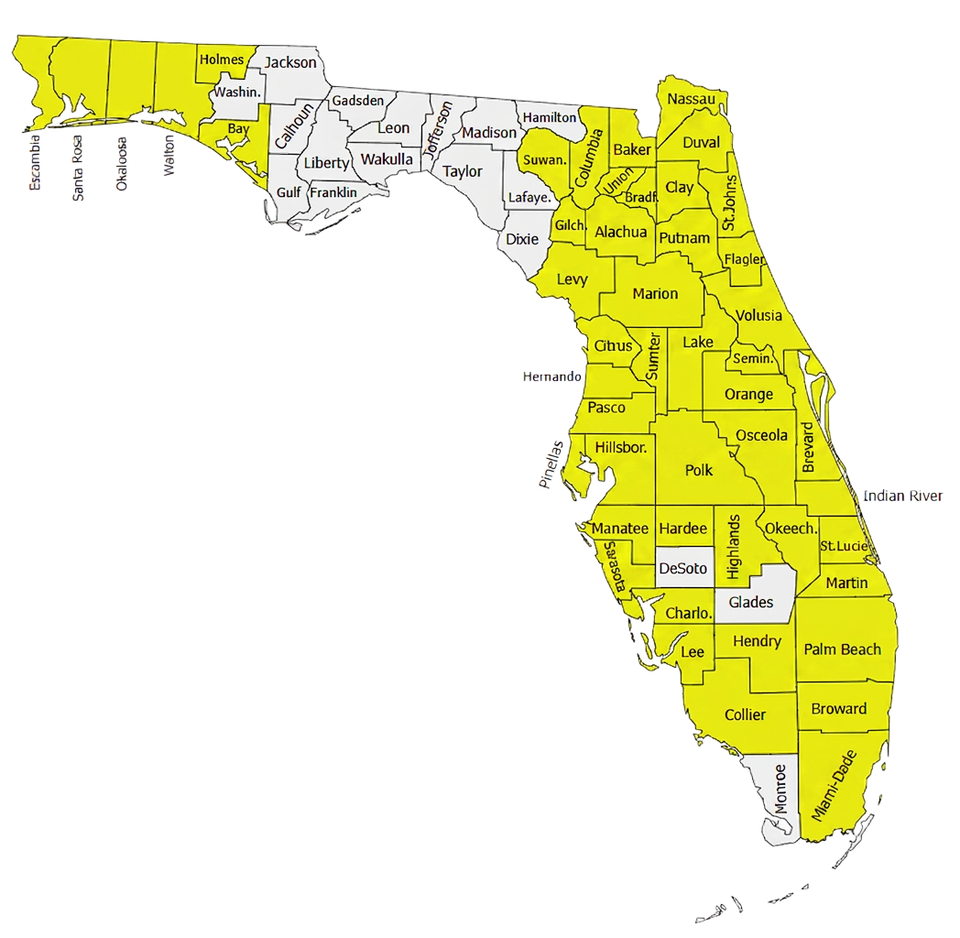
Florida-licensed physical therapists covering 50+ counties in Florida.
Our clinicians reach major metros and rural communities alike — from the Panhandle to the Keys. Patients are typically seen at home or at their workplace within 48 hours of a complete referral.
- Clinicians on our team
- Statewide
- Florida counties covered
- 50+
Need to refer a Florida patient?
Our intake team confirms auto insurance coverage during the call and schedules most patients at home or at their workplace within 48 hours.