
HB 837: Florida's 2-Year Statute of Limitations, Explained
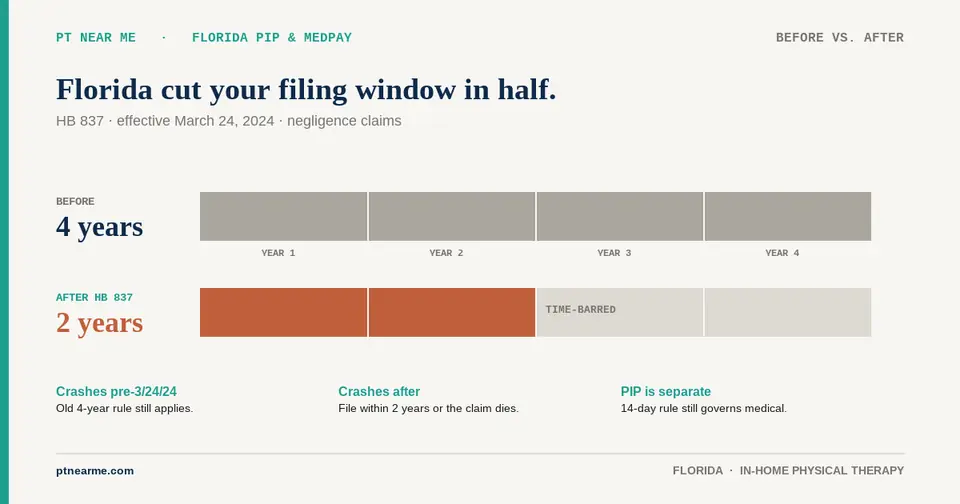
Florida House Bill 837, signed in March 2023, cut the statute of limitations for most personal-injury lawsuits from four years to two. If you were injured in a Florida car accident on or after March 24, 2023, you now have two years from the date of the crash to file suit — not four. That shorter clock makes timely medical care and documentation more important than it used to be.
PT Near Me
Florida-licensed in-home physical therapy team
The short answer
If you were injured in a Florida motor-vehicle crash on or after March 24, 2023, you have two years from the date of the crash to file a personal-injury lawsuit. Before HB 837, that window was four years. Older cases — where the injury occurred before March 24, 2023 — generally remain on the previous four-year clock, but anything more recent is on the new two-year clock.
This is a separate deadline from the 14-day rule under Florida law. The 14-day rule controls insurance coverage; the two-year limit controls when you can sue. Both clocks start at the crash and both can quietly expire if no one's tracking them.
What HB 837 actually changed
House Bill 837 was signed into law on March 24, 2023. The headline change for crash victims is the limitations period:
| When the cause of action accrued | Statute of limitations to file suit |
|---|---|
| Before March 24, 2023 | 4 years (prior law) |
| On or after March 24, 2023 | 2 years (HB 837) |
HB 837 also reworked Florida's comparative-negligence framework and modified rules around bad-faith insurance claims. Those changes matter for case strategy, but the limitations cut is the one that most directly affects how an injured patient plans treatment and documentation.
Why a shorter clock changes how treatment is documented
Under the old four-year window, it was common for a crash victim to complete PT, reach maximum medical improvement, and still have years before the limitations period closed. The two-year window collapses that runway. The practical effect for patients:
- PT should be initiated promptly, completed without long gaps, and documented clearly from the first visit.
- Reassessments and discharge summaries with residual deficits need to be ready substantially sooner than they used to be.
- Patients who delay starting PT — even by a few months — meaningfully reduce the time available for treatment and evaluation before the limitations period closes.
What HB 837 did not change
- Every Florida-registered vehicle is still required to carry auto insurance, and your own auto policy pays first regardless of fault.
- The clinical standard of care for after a crash physical therapy is unchanged — early, active rehabilitation remains the evidence-based path.
- PT Near Me's billing approach is unchanged: we bill the patient's auto insurance for crash-related care; we do not bill regular health insurance or Medicare.
What injured patients should actually do
- Get seen by a qualifying provider — MD, DO, dentist, PA, ARNP, or hospital — within 14 days of the crash to preserve coverage for crash-related care.
- Start physical therapy promptly once cleared, so treatment is well documented from the beginning.
- Start physical therapy promptly once cleared. The same evidence base that supports early PT clinically also produces a clean record before the two-year clock runs.
- Keep copies of every medical record from the date of the crash forward.
Related resources
Frequently asked questions
- Does HB 837 apply to my case if the crash happened in 2022?
- Generally no. The two-year statute of limitations applies to causes of action that accrued on or after March 24, 2023. Crashes before that date are typically on the prior four-year clock.
- Does this shorter deadline affect how long I can continue physical therapy?
- No. HB 837 limits the time to file suit, not the duration of medically necessary treatment. PT continues for as long as it's clinically indicated and a coverage source — the patient's auto insurance, in our case — supports it.
- I missed the 14-day window. Is the two-year deadline also gone?
- No. Missing the 14-day window can end coverage for the crash but does not affect the two-year statute of limitations on a personal-injury lawsuit. The two clocks are independent.
- Should a lawsuit be filed immediately to be safe?
- Not necessarily. Most cases are worked up — treatment completed, records gathered, demand made — before a lawsuit is filed. The point is that the two-year window leaves less room for delay; the calendar deadline is something to track carefully.
Related articles
- Recovering After a Crash
How Soon Should You Start PT After a Car Accident in Florida?
In Florida, the practical answer is within 14 days — both because Florida law requires initial care in that window and because the clinical evidence strongly favors early intervention for soft-tissue and cervical-spine injuries.
PT Near Me · May 2, 2026
- Recovering After a Crash
Whiplash After a Florida Car Accident: What to Expect in Recovery
Most whiplash recovers within 6 to 12 weeks with early, active physical therapy. A smaller share develops persistent symptoms past three months. Here's what whiplash actually is, what the realistic timeline looks like, and how PT should approach it after a crash in Florida.
PT Near Me · June 21, 2026
- Recovering After a Crash
Hip Pain After a Car Accident: Causes & Treatment
Hip pain after a Florida car accident is usually the result of dashboard impact, seatbelt loading, or twisting forces — and most cases respond well to early, structured physical therapy. Here is what causes it, what the red flags are, and how auto insurance pays for in-home PT.
PT Near Me · June 28, 2026
In your city
Conditions we treat across Florida
Each guide below covers the clinical evidence, recovery timelines, and coverage details specific to these conditions.
Don’t see your city? View all Florida service areas.
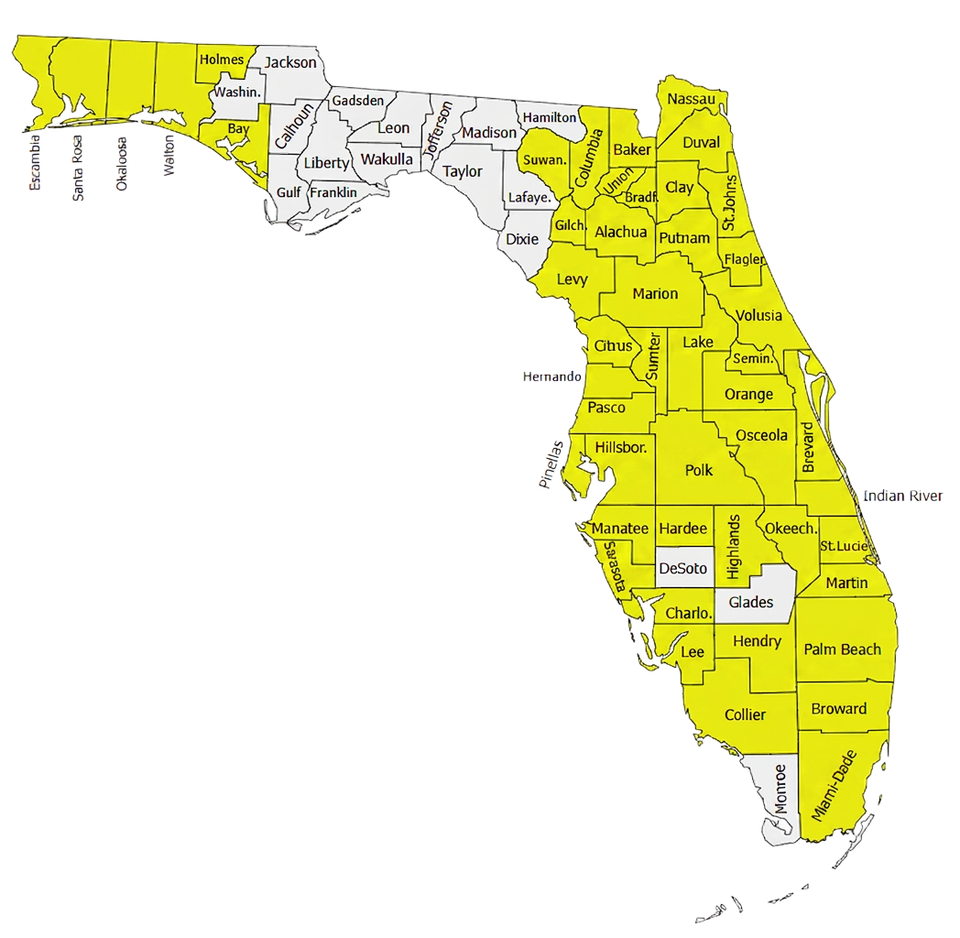
Florida-licensed physical therapists covering 50+ counties in Florida.
Our clinicians reach major metros and rural communities alike — from the Panhandle to the Keys. Patients are typically seen at home or at their workplace within 48 hours of a complete referral.
- Clinicians on our team
- Statewide
- Florida counties covered
- 50+
Need to refer a Florida patient?
Our intake team confirms auto insurance coverage during the call and schedules most patients at home or at their workplace within 48 hours.