Statewide clinical guide
Knee Sprain, Meniscus & Post-Operative Knee — In-Home Physical Therapy in Florida
Knee injuries after a Florida collision usually fall into one of three buckets: a contusion or sprain from the knee striking the dashboard, a twisting injury when the foot is planted on the brake at impact, or a post-operative knee whose course was accelerated by the crash. The collateral ligaments (MCL, LCL), the meniscus, and the patellofemoral joint are most commonly involved. Isolated ACL tears from a crash mechanism are less common but do occur; the U.S. sees an estimated 100,000–200,000 ACL injuries each year across all mechanisms[1].
The knee is unusually responsive to early, structured rehab because so much of normal function depends on quadriceps activation — and quadriceps inhibition (the reflexive shut-off of the quad after injury) is the single biggest reason knees stay weak and painful months after the injury itself has healed[2]. The landmark METEOR trial[3] and the Finnish FIDELITY trial[4] both showed that PT produces equivalent 12-month outcomes to arthroscopic partial meniscectomy for degenerative meniscal tears. For ACL injuries, the KANON trial[5] demonstrated equivalent 2- and 5-year outcomes between structured rehab plus optional delayed reconstruction and immediate reconstruction. Neuromuscular electrical stimulation early after surgery accelerates quadriceps strength recovery[6].
Common symptoms & presentation
- ·Pain on the inside or outside of the knee (suggests collateral ligament)
- ·Pain along the joint line with twisting or squatting (suggests meniscus)
- ·Swelling within the first 24 hours (suggests intra-articular bleeding — flag the DPT)
- ·Instability or giving way when changing direction
- ·Stiffness with prolonged sitting (theater sign — common with patellofemoral pain)
- ·Inability to fully straighten or fully bend the knee
By the numbers
- 100–200kU.S. ACL injuries per yearSource [1]
- 0% benefitof meniscectomy vs PT for degenerative tears (FIDELITY)Source [4]
- 9 monthsminimum to safely return to cutting sports post-ACLRSource [8]
- <15%quadriceps side-to-side deficit target before progressionSource [6]
How in-home PT treats knee & hip injuries
Knee evaluation includes goniometric ROM (flexion/extension), manual muscle testing of the quad, hamstring, and hip stabilizers, special tests for collaterals (valgus/varus stress), cruciates (Lachman, anterior/posterior drawer), and meniscus (McMurray's, Thessaly), and a functional assessment of gait, sit-to-stand, and single-leg balance. Quadriceps activation is measured against the uninvolved side, with a target of <15% side-to-side deficit before return-to-activity progression[6].
Treatment starts with effusion management, restoration of full passive extension (the single biggest predictor of long-term function), and quad activation drills — often with portable NMES[6]. From there the program progresses through open-chain strengthening, closed-chain loading (sit-to-stand, step-ups, mini-squats), and finally to dynamic stability work. Post-operative patients follow the surgeon's specific protocol; the APTA / JOSPT knee CPGs[7] outline the evidence base for meniscus, ACL, and patellofemoral programs.
Typical recovery timeline
Grade I/II ligament sprains and uncomplicated meniscal injuries typically resolve in 8 to 14 visits over 6 to 10 weeks. Post-operative ACL reconstruction is a 9 to 12 month program with PT 2–3 times per week early on. Return-to-sport before 9 months post-op is associated with a roughly 7x higher reinjury risk[8].
When to escalate
These signs are not routine and warrant immediate physician contact or an ER visit.
- ·Rapid effusion within the first hour (suggests cruciate or fracture)
- ·Inability to bear any weight on the leg
- ·Locked knee that cannot be fully extended (suggests displaced meniscal tear)
- ·Calf swelling, warmth, or tenderness (rule out DVT)
Insurance coverage
Florida law requires the initial medical visit within 14 days of the crash. Once that window is met, PT Near Me bills the patient’s auto insurance for medically necessary in-home rehab. We do not bill regular health insurance or Medicare.
Knee & Hip Injuries PT in your Florida city
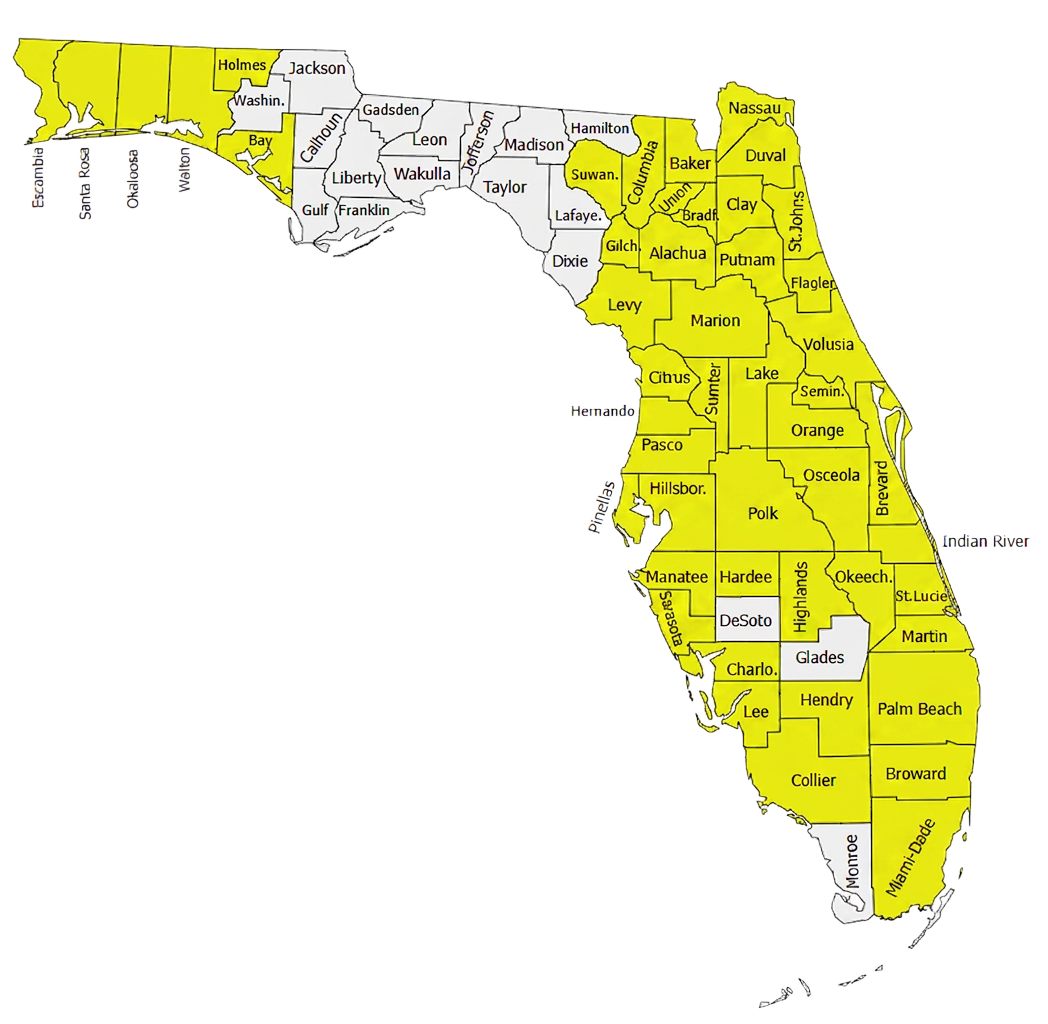
We treat knee & hip injuries across 50+ Florida counties. Pick a city to see local hospitals, crash corridors, and coverage notes for that market.
- Tampa, FLHillsborough County
- Wesley Chapel, FLPasco County
- Brandon, FLHillsborough County
- Clearwater, FLPinellas County
- St. Petersburg, FLPinellas County
- Lakeland, FLPolk County
- Orlando, FLOrange County
- Kissimmee, FLOsceola County
- Ocala, FLMarion County
- Spring Hill, FLHernando County
- Sarasota, FLSarasota County
- Bradenton, FLManatee County
- Riverview, FLHillsborough County
- Land O' Lakes, FLPasco County
- Palm Harbor, FLPinellas County
- New Port Richey, FLPasco County
- Trinity, FLPasco County
- Brooksville, FLHernando County
- Homosassa, FLCitrus County
- Hudson, FLPasco County
- Oldsmar, FLPinellas County
- Largo, FLPinellas County
- Plant City, FLHillsborough County
- Sun City Center, FLHillsborough County
- Parrish, FLManatee County
- Port Charlotte, FLCharlotte County
- Auburndale, FLPolk County
- The Villages, FLSumter County
- Wildwood, FLSumter County
- Leesburg, FLLake County
- Eustis, FLLake County
- Tavares, FLLake County
- Mount Dora, FLLake County
- Clermont, FLLake County
- Winter Garden, FLOrange County
- Apopka, FLOrange County
- Melbourne, FLBrevard County
- Daytona Beach, FLVolusia County
- Gainesville, FLAlachua County
- West Palm Beach, FLPalm Beach County
- Jupiter, FLPalm Beach County
- Fort Lauderdale, FLBroward County
- Pembroke Pines, FLBroward County
- Miami, FLMiami-Dade County
- Naples, FLCollier County
- Tallahassee, FLLeon County
- Pensacola, FLEscambia County
- Jacksonville, FLDuval County
- Fort Myers, FLLee County
- Cape Coral, FLLee County
Knee & Hip Injuries FAQ
- Will PT work for a meniscus tear, or do I need surgery?
- The current evidence — the METEOR and FIDELITY trials — shows that for degenerative meniscal tears, PT produces equivalent outcomes to arthroscopic surgery at 1 and 2 years. Acute traumatic tears in younger patients are more often surgical. Your DPT and orthopedic physician will help decide.
- Can I do knee PT at home when I can't drive?
- Yes — and this is one of the most common scenarios we see, especially in the first 2–6 weeks post-op when driving is unsafe due to weight-bearing restrictions or narcotic use.
- How important is regaining full extension?
- Critical. Even 5° of lost extension changes gait mechanics permanently and is associated with long-term knee dysfunction. Getting it back early is one of the highest priorities of the plan of care.
References & clinical evidence
All statistics on this page are sourced from peer-reviewed journals, clinical practice guidelines, or U.S. government health agencies.
- [1]Anterior Cruciate Ligament Injuries — clinical overview— NIH / StatPearls, 2023
- [2]Quadriceps activation failure after anterior cruciate ligament rupture— Journal of Athletic Training, 1999
- [3]Surgery versus physical therapy for a meniscal tear and osteoarthritis (METEOR)— NEJM, 2013
- [4]Arthroscopic Partial Meniscectomy versus Sham Surgery (FIDELITY)— NEJM, 2013
- [5]A randomized trial of treatment for acute anterior cruciate ligament tears (KANON)— NEJM, 2010
- [6]Neuromuscular electrical stimulation after ACL reconstruction — Cochrane review— Cochrane Database Syst Rev, 2010
- [7]Knee Stability and Movement Coordination Impairments: Knee Ligament Sprain — CPG— JOSPT / APTA, 2017
- [8]Simple decision rules can reduce reinjury risk by 84% after ACL reconstruction— BJSM, 2016
Related reading
How Soon Should You Start PT After a Car Accident in Florida?
In Florida, the practical answer is within 14 days — both because Florida law requires initial care in that window and because the clinical evidence strongly favors early intervention for soft-tissue and cervical-spine injuries.
What to Expect at Your First In-Home Physical Therapy Visit
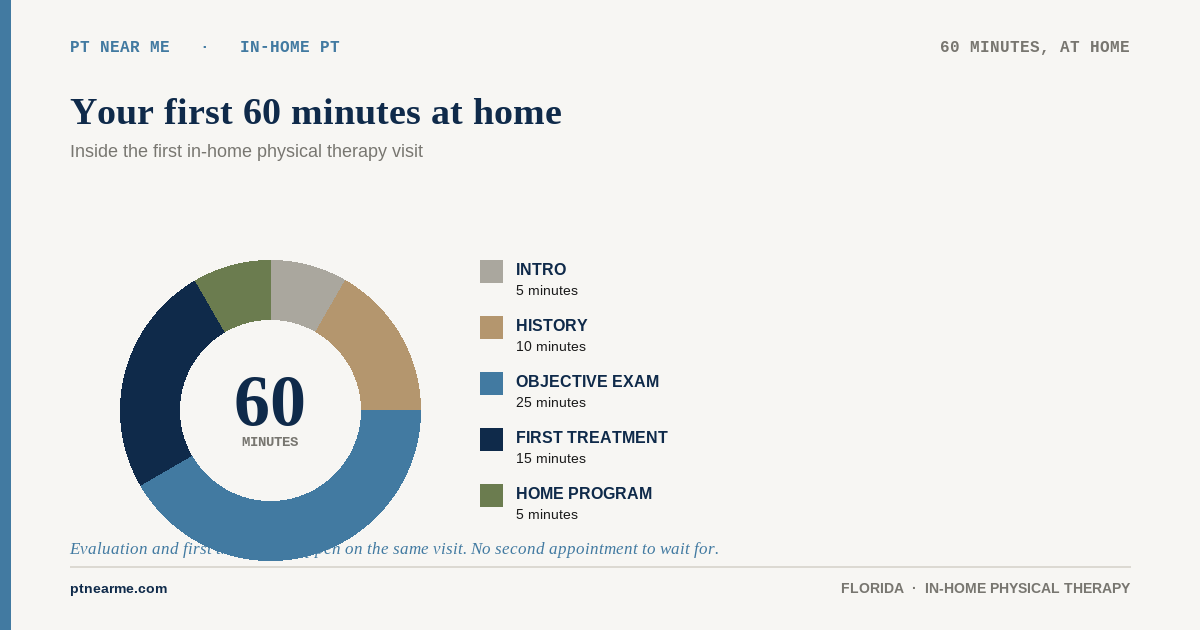
A minute-by-minute breakdown of what happens at your first in-home physical therapy visit in Florida — what the therapist brings, how the evaluation works, and what you should have ready.
Mobile Physical Therapy: The In-Home PT Guide for Florida Patients
How mobile, in-home physical therapy actually works in Florida — from referral and first visit to discharge — and when it's the right level of care.
Get a knee & hip injuries patient seen at home — usually within 48 hours.
Florida-licensed physical therapists covering 50+ counties in Florida.
Our clinicians reach major metros and rural communities alike — from the Panhandle to the Keys. Patients are typically seen at home or at their workplace within 48 hours of a complete referral.
- Clinicians on our team
- Statewide
- Florida counties covered
- 50+