Statewide clinical guide
Herniated Disc & Lumbar Radiculopathy — In-Home Physical Therapy in Florida
A herniated disc — bulging or extruded nuclear material pressing on a nerve root — is one of the most common findings on post-crash MRI, and also one of the most over-treated. The peer-reviewed data is clear: imaging finding correlates poorly with symptoms. A classic study found 52% of asymptomatic adults had a lumbar disc bulge on MRI[1], and a 2015 systematic review confirmed disc degeneration findings in 37% of asymptomatic 20-year-olds rising to 96% by age 80[2]. The question is not whether there's a herniation on the scan — it's whether symptoms follow a nerve-root distribution and whether they're improving over time.
Conservative care for lumbar radiculopathy — McKenzie-style directional preference, neural mobilization, progressive trunk and hip strengthening — produces equivalent 2-year outcomes to surgery in the majority of patients. The SPORT trial[3][4] randomized patients with confirmed disc herniation to surgery or non-operative care and found both groups improved substantially, with surgery offering only modest additional short-term benefit that converged by 2 years. The North American Spine Society guideline[5] recommends 6 weeks of non-operative care before considering surgery in patients without progressive neurologic deficit, and the APTA / JOSPT lumbar CPG[6] specifically endorses McKenzie-style directional preference treatment for centralization-responsive patients[7].
Common symptoms & presentation
- ·Radiating leg pain (often deeper and more burning than the back pain itself)
- ·Numbness or tingling in a specific dermatome (L4: medial calf; L5: top of foot; S1: lateral foot)
- ·Weakness in a specific myotome (L4: knee extension; L5: ankle dorsiflexion / great toe extension; S1: plantarflexion)
- ·Pain worse with sitting, coughing, or sneezing (increases intradiscal pressure)
- ·Centralization — pain moving from the leg toward the back — is a positive prognostic sign
By the numbers
- 52%of asymptomatic adults show a lumbar disc bulge on MRISource [1]
- 37%→96%asymptomatic disc degeneration: age 20 → age 80Source [2]
- 90%of acute sciatica resolves non-operatively in 6–12 weeksSource [5]
- Equivalent2-year outcomes: surgery vs non-op care (SPORT)Source [4]
How in-home PT treats herniated disc
Evaluation includes a full neurologic screen (myotomes, dermatomes, reflexes), straight-leg raise, slump test, and a McKenzie-style repeated-motion exam to identify a directional preference[7]. Most lumbar disc patients centralize with repeated extension, though a minority prefer flexion. The DPT documents baseline pain location, the most distal symptom, and the functional limitations the patient cares about most.
Treatment matches the directional preference: most patients receive prone press-ups, sustained extension positioning, and education on neutral spine mechanics. As symptoms centralize, the program adds neural mobilization (sliders and tensioners) and progressive lumbar stabilization[6]. Manual therapy — lumbar mobilization, soft tissue work to the paraspinals and gluteals — is layered in based on response.
Typical recovery timeline
Most uncomplicated lumbar radiculopathies improve substantially in 8 to 14 visits over 6 to 10 weeks. Patients who centralize within the first 2 weeks of PT have substantially better prognosis[7]. About 90% of acute sciatica resolves with non-operative care within 6–12 weeks[5].
When to escalate
These signs are not routine and warrant immediate physician contact or an ER visit.
- ·Saddle anesthesia, bowel or bladder dysfunction (cauda equina — surgical emergency)
- ·Progressive motor weakness (e.g. worsening foot drop)
- ·Bilateral leg symptoms
- ·Severe, unrelenting pain unresponsive to position changes
Insurance coverage
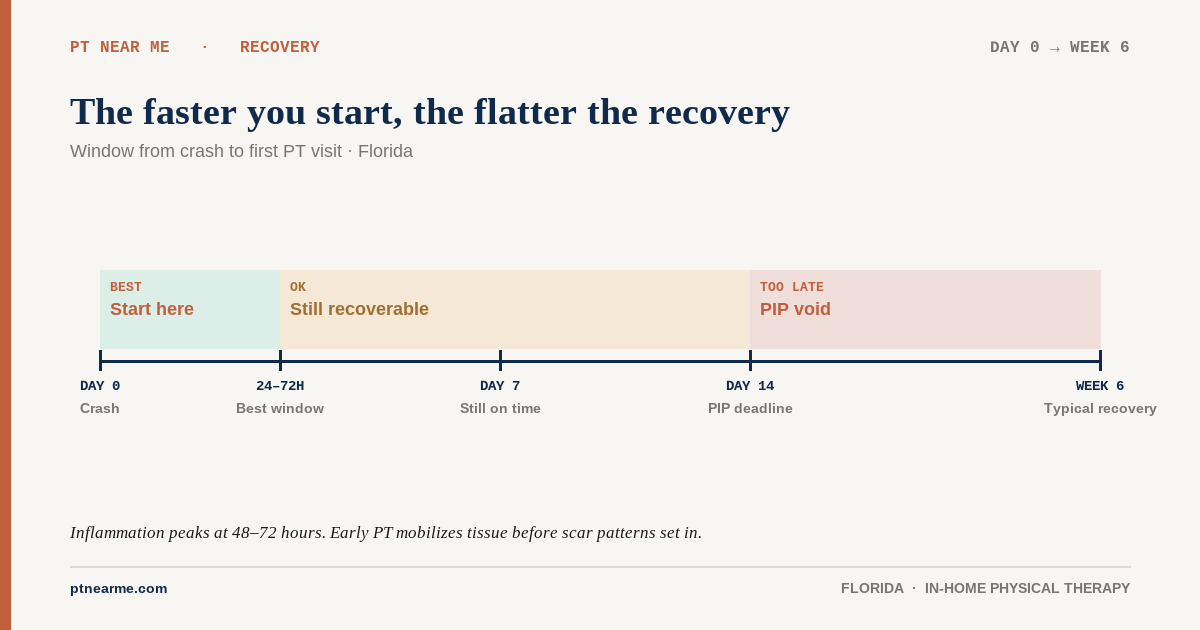
Florida law requires the initial medical visit within 14 days of the crash. Once that window is met, PT Near Me bills the patient’s auto insurance for medically necessary in-home rehab. We do not bill regular health insurance or Medicare.
Herniated Disc PT in your Florida city
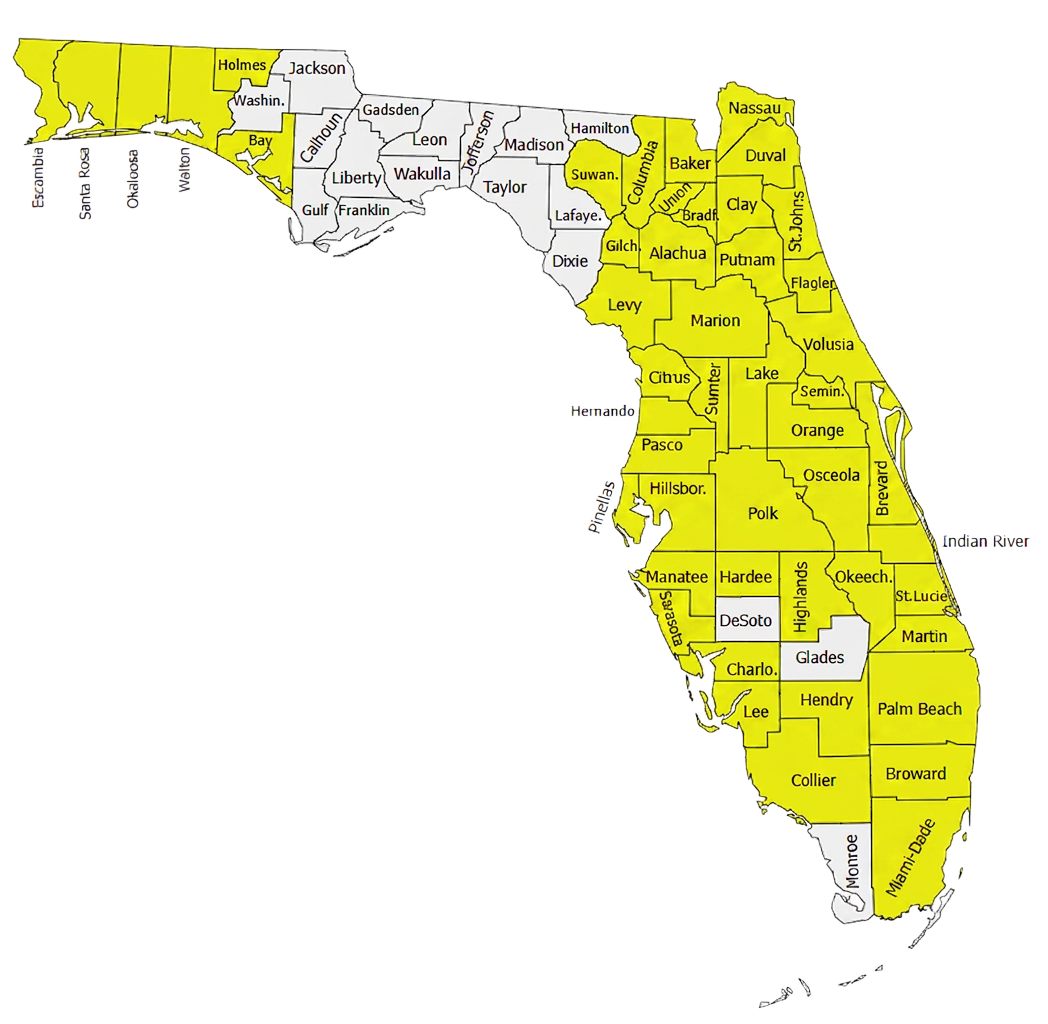
We treat herniated disc across 50+ Florida counties. Pick a city to see local hospitals, crash corridors, and coverage notes for that market.
- Tampa, FLHillsborough County
- Wesley Chapel, FLPasco County
- Brandon, FLHillsborough County
- Clearwater, FLPinellas County
- St. Petersburg, FLPinellas County
- Lakeland, FLPolk County
- Orlando, FLOrange County
- Kissimmee, FLOsceola County
- Ocala, FLMarion County
- Spring Hill, FLHernando County
- Sarasota, FLSarasota County
- Bradenton, FLManatee County
- Riverview, FLHillsborough County
- Land O' Lakes, FLPasco County
- Palm Harbor, FLPinellas County
- New Port Richey, FLPasco County
- Trinity, FLPasco County
- Brooksville, FLHernando County
- Homosassa, FLCitrus County
- Hudson, FLPasco County
- Oldsmar, FLPinellas County
- Largo, FLPinellas County
- Plant City, FLHillsborough County
- Sun City Center, FLHillsborough County
- Parrish, FLManatee County
- Port Charlotte, FLCharlotte County
- Auburndale, FLPolk County
- The Villages, FLSumter County
- Wildwood, FLSumter County
- Leesburg, FLLake County
- Eustis, FLLake County
- Tavares, FLLake County
- Mount Dora, FLLake County
- Clermont, FLLake County
- Winter Garden, FLOrange County
- Apopka, FLOrange County
- Melbourne, FLBrevard County
- Daytona Beach, FLVolusia County
- Gainesville, FLAlachua County
- West Palm Beach, FLPalm Beach County
- Jupiter, FLPalm Beach County
- Fort Lauderdale, FLBroward County
- Pembroke Pines, FLBroward County
- Miami, FLMiami-Dade County
- Naples, FLCollier County
- Tallahassee, FLLeon County
- Pensacola, FLEscambia County
- Jacksonville, FLDuval County
- Fort Myers, FLLee County
- Cape Coral, FLLee County
Herniated Disc FAQ
- If my MRI shows a herniation, do I need surgery?
- Usually not. The SPORT trial and others show equivalent 2-year outcomes between surgery and conservative care for most lumbar disc herniations. Surgery is appropriate for cauda equina, progressive neurologic deficit, or failed conservative care after 6–12 weeks.
- Will lying down all day help my disc heal?
- No. Brief positioning (e.g. prone on elbows for 5 minutes) can reduce symptoms, but prolonged bed rest weakens the trunk muscles and prolongs recovery.
- What is centralization and why does the PT keep asking about it?
- Centralization is when leg pain moves toward the back during specific movements. It's one of the strongest positive prognostic signs in lumbar radiculopathy — patients who centralize have substantially better outcomes than those who don't.
References & clinical evidence
All statistics on this page are sourced from peer-reviewed journals, clinical practice guidelines, or U.S. government health agencies.
- [1]Magnetic resonance imaging of the lumbar spine in people without back pain— NEJM, 1994
- [2]Systematic literature review of imaging features of spinal degeneration in asymptomatic populations— AJNR, 2015
- [3]Surgical vs nonoperative treatment for lumbar disk herniation — SPORT 2-year results— JAMA, 2006
- [4]SPORT — 4-year and 8-year follow-up of lumbar disk herniation— Spine, 2008
- [5]NASS Clinical Guideline for Lumbar Disc Herniation with Radiculopathy— North American Spine Society, 2012
- [6]Low Back Pain — Clinical Practice Guidelines linked to ICF— JOSPT / APTA, 2012
- [7]Centralization as a predictor of treatment outcome in low back pain— Spine, 2004
Related reading
How Soon Should You Start PT After a Car Accident in Florida?
In Florida, the practical answer is within 14 days — both because Florida law requires initial care in that window and because the clinical evidence strongly favors early intervention for soft-tissue and cervical-spine injuries.
Mobile Physical Therapy: The In-Home PT Guide for Florida Patients
How mobile, in-home physical therapy actually works in Florida — from referral and first visit to discharge — and when it's the right level of care.
What to Expect at Your First In-Home Physical Therapy Visit
A minute-by-minute breakdown of what happens at your first in-home physical therapy visit in Florida — what the therapist brings, how the evaluation works, and what you should have ready.
Get a herniated disc patient seen at home — usually within 48 hours.
Florida-licensed physical therapists covering 50+ counties in Florida.
Our clinicians reach major metros and rural communities alike — from the Panhandle to the Keys. Patients are typically seen at home or at their workplace within 48 hours of a complete referral.
- Clinicians on our team
- Statewide
- Florida counties covered
- 50+