
A Physician's Guide to Post-Discharge In-Home PT in Florida
When a Florida auto-accident patient leaves your ER or post-op visit with a PT referral, the single biggest determinant of whether they actually complete care is whether the therapy is accessible. In-home PT closes the post-discharge attendance gap and returns clinic-equivalent documentation to your office.
PT Near Me
Florida-licensed in-home physical therapy team
The short answer
If your after a crash patient leaves discharge with a PT script and no reliable way to attend a clinic, the attendance failure is predictable and largely preventable. In-home PT removes the transportation and scheduling barriers responsible for most after a crash dropouts and returns documentation calibrated to outpatient standards — the same standards the referring physician's records are built on.
The post-discharge attendance problem
When patients drop out of outpatient PT after an auto accident, the reasons cluster into a short list of logistical barriers: no working vehicle in the first 4–6 weeks after the crash, pain or anxiety about riding as a passenger, inability to take three afternoons off work without losing pay or childcare, and clinics that don't match where the patient actually lives. Clinical disagreement with the plan of care is rarely on the list.
From the referring physician's perspective, the visible signal is a thin or incomplete PT record at the next follow-up. From the patient's perspective, it's a treatment plan that was never realistic given the post-crash logistics.
When in-home PT is the right level of care
In-home outpatient PT fits patients who would otherwise be referred to a clinic but face material barriers to attendance. Typical referrals:
- Post-MVA cervical and lumbar soft-tissue injuries (WAD I–II, mechanical low-back pain).
- Post-concussive syndromes with vestibular or cervicogenic contributions.
- Post-surgical orthopedic cases — rotator cuff, ACL, total knee, total hip — within the surgeon's protocol.
- Older adults with after a crash balance, gait, and fall-prevention needs.
- Working-age patients whose schedules cannot accommodate three weekly clinic visits.
Patients who require advanced clinic-only treatments, hydrotherapy, or large fixed equipment may be more appropriately seen in a clinic. The in-home model is otherwise clinically equivalent to outpatient PT.
The evidence base for early, active PT
The clinical literature consistently supports early, active rehabilitation after musculoskeletal injury. A 2018 Stanford and Duke study published in JAMA Network Open (88,985 patients) found that patients who started physical therapy soon after a diagnosis of shoulder, neck, low-back, or knee pain were about 7–16% less likely to use opioids in the following months. Research on early PT after emergency-department visits for low-back pain has linked early PT with lower risk of lumbar surgery, lower likelihood of long-term opioid use, and lower overall costs. The U.S. Centers for Disease Control and Prevention and the American College of Physicians both recommend non-drug treatments such as physical therapy as a first-line option for musculoskeletal and chronic pain.
Removing the attendance barrier is how that evidence base reaches the patient. The clinical content of the visit is unchanged by the location; the probability of the patient receiving it is not.
What documentation the referring physician receives
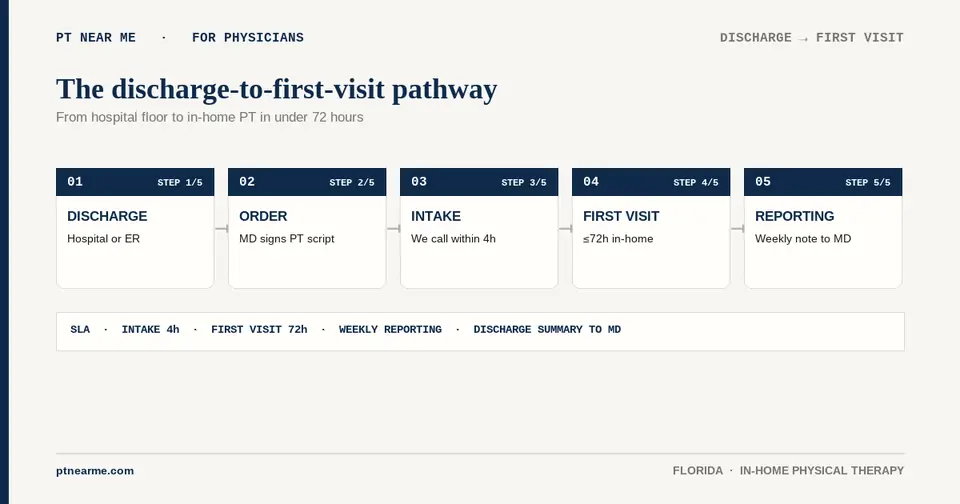
- Initial evaluation within 24–48 hours of a complete referral, sent to the referring office.
- Periodic progress notes at clinical reassessment intervals.
- Discharge summary with subjective and objective findings, treatment course, functional progress, residual deficits, and prognostic statements.
- Itemized visit-by-visit notes available on request, tied to the active plan of care.
Auto insurance, coverage, and the 14-day rule
Florida law requires initial medical care within 14 days of the crash for coverage to apply. A qualifying provider — MD, DO, dentist, PA, ARNP, or hospital — must perform that initial visit; a physical therapist or chiropractor cannot satisfy it alone. Once that visit is in place, PT can begin under the physician's referral and is billed to the patient's auto insurance. PT Near Me does not bill regular health insurance or Medicare.
How to refer
- Send the standard PT referral with the diagnosis, mechanism of injury, and any precautions or restrictions.
- Include the date of loss and confirm a qualifying-provider visit occurred within the 14-day window so coverage is preserved.
- Our intake team confirms coverage, schedules the in-home evaluation within 24–48 hours, and returns the initial evaluation to your office on the same cadence a clinic would.
Related resources
Frequently asked questions
- Do you accept referrals from any specialty, or only orthopedics?
- We accept referrals from any treating physician — emergency medicine, primary care, orthopedics, neurology, physiatry, and pain management. The after a crash care pathway runs across all of these depending on the patient's injuries.
- How do you handle surgical protocols?
- We follow the surgeon's prescribed post-op protocol, request clarification when needed, and coordinate directly with the surgical office on milestone progression and weight-bearing or ROM changes.
- Will my office be billed for reports?
- No. Documentation returned to the referring physician — initial evaluation, progress notes, discharge summary — is provided at no charge as part of normal continuity of care.
- What happens if the auto insurance benefit is exhausted mid-treatment?
- PT Near Me does not bill regular health insurance or Medicare, so if the auto insurance benefit is exhausted we will discuss options with the patient before continuing. The clinical pathway and reporting cadence to your office do not change.
In your city
Conditions we treat across Florida
Each guide below covers the clinical evidence, recovery timelines, and coverage details specific to these conditions.
Don’t see your city? View all Florida service areas.
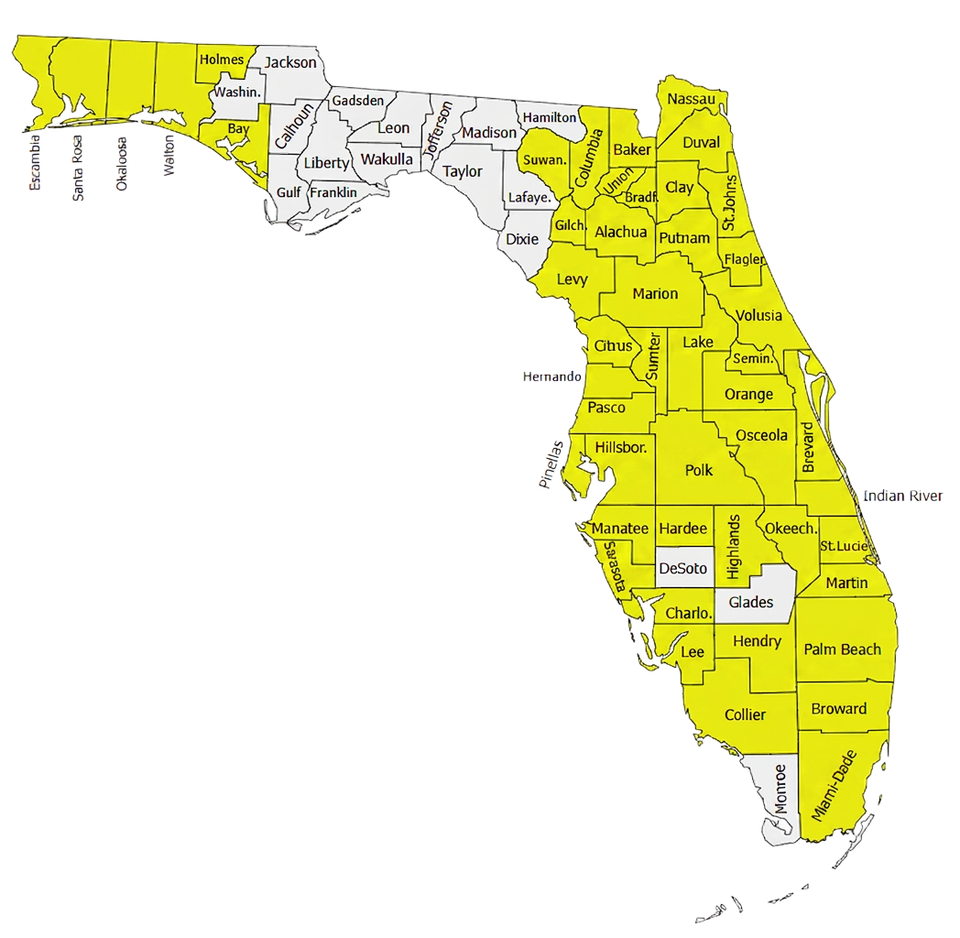
Florida-licensed physical therapists covering 50+ counties in Florida.
Our clinicians reach major metros and rural communities alike — from the Panhandle to the Keys. Patients are typically seen at home or at their workplace within 48 hours of a complete referral.
- Clinicians on our team
- Statewide
- Florida counties covered
- 50+
Need to refer a Florida patient?
Our intake team confirms auto insurance coverage during the call and schedules most patients at home or at their workplace within 48 hours.