
Treating Auto-Accident Patients: What Florida PTs and PTAs Should Know About PIP
Florida's no-fault PIP statute (Fla. Stat. § 627.736) creates a steady, motivated referral pipeline for in-home PT — but only if patients are seen within 14 days of the crash. Here's what clinicians need to know.

Dr. Sam Rose, PT, DPT
Clinical Director, PT Near Me
Why PIP matters to your caseload
If you're a Florida PT or PTA considering in-home auto-injury work, the single most important piece of regulatory context is Personal Injury Protection — PIP. It's the no-fault auto insurance coverage that every Florida-registered vehicle is required to carry, and it's the payor source for nearly every patient on a mobile auto-injury caseload. Understanding how it works tells you why the referral pipeline is steady and why the patient population is so motivated.
What PIP actually is
PIP is no-fault: it pays for medically necessary care after a crash regardless of who caused it. The statute is Florida Statute § 627.736. Two rules drive everything that happens clinically:
- Initial care within 14 days. If the patient isn't seen by a qualifying provider within 14 days of the accident, PIP benefits for that crash are forfeited.
- EMC vs. non-EMC. Full $10,000 benefits require documentation of an Emergency Medical Condition by a physician, PA, ARNP, or dentist. Without it, the cap drops to $2,500.
“In order to be eligible for [PIP] benefits, an insured must receive initial services and care … within 14 days after the motor vehicle accident.”
Why this creates a steady, motivated caseload
The 14-day rule fundamentally changes patient behavior. In most states, a soft-tissue patient might wait weeks before seeing anyone about back or neck pain after a fender-bender. In Florida, they can't. If they don't act fast, they lose their benefit entirely. That collapses the timeline from "someday" to "this week."
- Florida runs around 400,000+ reportable traffic crashes per year (Florida DHSMV crash dashboard).
- The vast majority of injured occupants in those crashes will need to make a PIP eligibility decision within 14 days.
- Physicians, urgent cares, and chiropractors all generate referrals into PT during that window.
From the clinician's perspective: you're not chasing patients. The pipeline exists because the statute makes it exist. Your job is to be the licensed clinician who shows up, evaluates well, and documents correctly.
The clinical case is real, not just regulatory
The 14-day rule also happens to be excellent medicine. The research on early physical therapy for musculoskeletal pain — especially low back pain — consistently shows that getting patients into PT within about two weeks of onset is associated with significantly lower downstream healthcare utilization over the following year.
- Lower rates of opioid prescription.
- Fewer advanced imaging studies (MRI, CT) ordered.
- Fewer spinal injections.
- Fewer ED visits.
- Lower total spend on the episode of care.
(See, for example, Childs et al., BMC Health Services Research 2015; Frogner et al., Health Services Research 2018; and Liu et al., JAMA Network Open 2023, on early PT for low back pain and downstream cost.)
In other words: the patient population the statute funnels to you is the population the research says benefits most from early skilled PT. That's a clinically gratifying place to work.
How PT is billed against PIP
PT visits are billed against PIP using the same CPT codes you'd use in outpatient — evaluations (97161–97163), therapeutic exercise (97110), therapeutic activities (97530), neuromuscular re-education (97112), manual therapy (97140), gait training (97116), and re-evaluations (97164). The carrier applies the statutory rules: 14-day eligibility, EMC determination, and the $10,000 / $2,500 cap.
On the PT Near Me model, the practice handles PIP billing end-to-end. You document accurately and on time; we bill the auto policy, manage carrier follow-up, and apply MedPay if the auto policy includes it. We do not bill commercial health insurance for this caseload — keeping the payor mix narrow is part of what makes the documentation flow clean.
What clean PIP documentation looks like
PIP carriers are stricter on documentation than many commercial payors. The patterns that matter:
- Tie every visit to the accident. The injuries you're treating must be traceable to the crash mechanism.
- Justify medical necessity at every visit, not just the eval. Skilled rationale, measurable progress, and updated goals.
- Document EMC status when known — it's the difference between $10,000 and $2,500 in available benefits.
- Re-eval at the right intervals. Frequency justifications should be clearly tied to clinical findings.
- Communicate with the referring physician on the cadence they expect.
Our note templates and re-eval cadence are built around exactly these patterns. You don't have to invent a PIP-compliant workflow from scratch.
If you want this caseload
Frequently asked questions
- Do I need to be familiar with PIP before I start?
- Helpful but not required. You need to be a good clinician and a clean documenter. The practice handles the regulatory and billing side; we walk new clinicians through the documentation patterns PIP carriers expect.
- What happens if a patient comes to me past the 14-day window?
- Their PIP eligibility for that crash is generally forfeited. The case may still proceed under MedPay if the policy includes it, or be referred back upstream. Intake handles the eligibility determination before the visit lands on your schedule.
- What CPT codes get used?
- The standard outpatient PT codes — 97161–97164 for evals/re-evals, and treatment codes like 97110, 97530, 97112, 97140, and 97116. PIP doesn't have a separate code set.
- Are PIP patients usually compliant?
- In our experience, more compliant than the average outpatient population. They're early in recovery, in pain, and have a finite benefit window — they show up.
- Does PT Near Me bill commercial health insurance for any of this work?
- No. Our model bills Florida PIP and MedPay only. Keeping the payor narrow is a deliberate choice that simplifies documentation and intake.
Related articles
- Florida PIP & MedPay
Does Florida PIP Cover Physical Therapy After a Car Accident?
Yes — Florida Personal Injury Protection (PIP) covers medically necessary physical therapy after a car accident, but only if the patient is first evaluated by a qualifying provider within 14 days of the crash. Here's what that means in practice.
Dr. Sam Rose, PT, DPT · March 4, 2026
- Life as a PT/PTA with PT Near Me
What It's Like to Be a Mobile PT with PT Near Me
A realistic day-in-the-life of a Florida mobile physical therapist: 4–6 in-home visits, one-on-one care, post-MVA caseload, no productivity quotas, and the autonomy to actually treat.
Andre Bennett, PT, DPT · June 20, 2026
- Life as a PT/PTA with PT Near Me
How to Become a Mobile PT or PTA in Florida
A step-by-step guide to becoming a mobile, in-home physical therapist or PTA in Florida — licensure with the Florida Board of Physical Therapy, the credentials you'll need to contract, and how to actually start taking visits.
Andre Bennett, PT, DPT · June 23, 2026
In your city
Conditions we treat across Florida
Each city page below covers the clinical evidence, recovery timelines, and PIP details specific to these conditions.
- Whiplash — Tampa
- Whiplash — Orlando
- Whiplash — Miami
- Whiplash — St. Petersburg
- Low Back Pain — Tampa
- Low Back Pain — Orlando
- Low Back Pain — Miami
- Low Back Pain — St. Petersburg
- Concussion — Tampa
- Concussion — Orlando
- Concussion — Miami
- Concussion — St. Petersburg
- Shoulder Injury — Tampa
- Shoulder Injury — Orlando
- Shoulder Injury — Miami
- Shoulder Injury — St. Petersburg
Don’t see your city? View all Florida service areas.
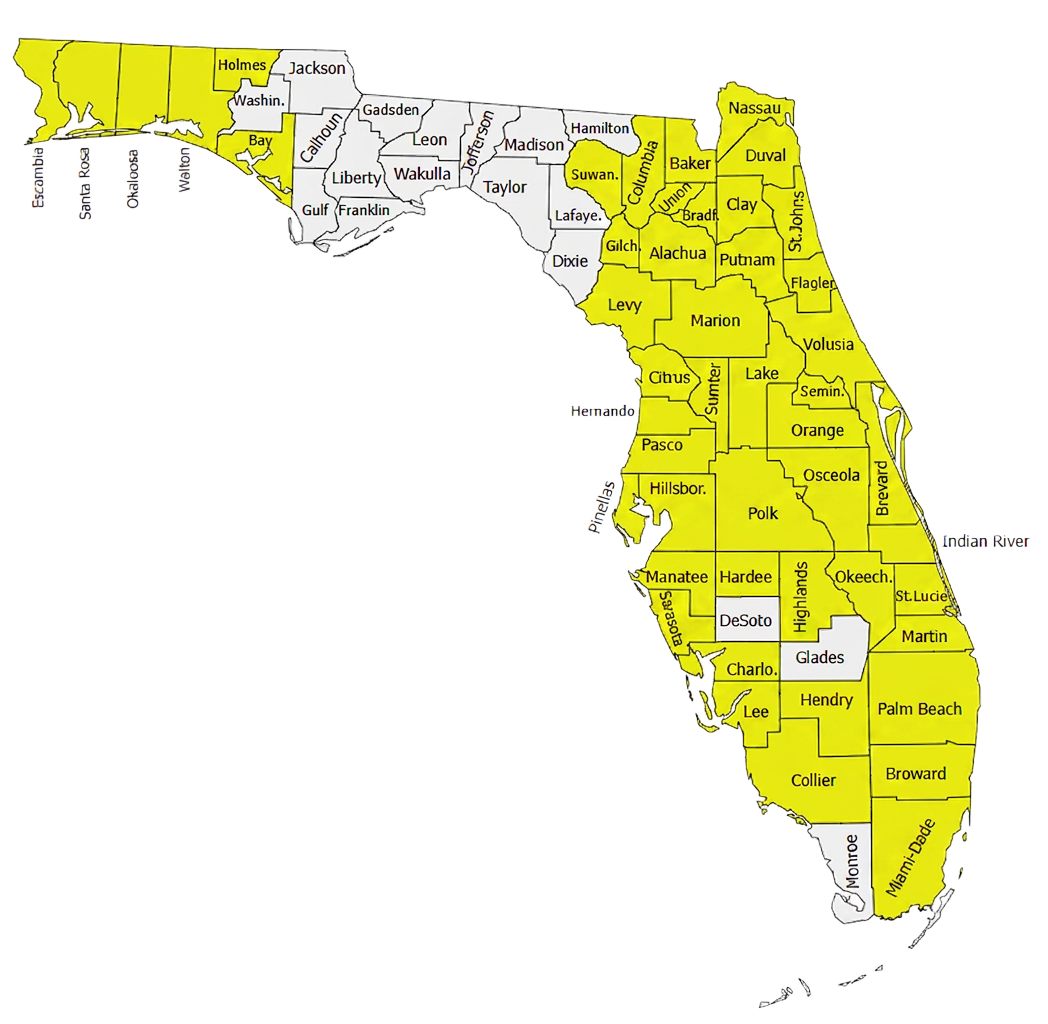
500+ Physical Therapists covering 35+ counties in Florida.
Our clinician network reaches major metros and rural communities alike — from the Panhandle to the Keys. If a patient is in a highlighted county, we can usually see them at home within 24–72 hours of intake.
- Clinicians in network
- 500+
- Florida counties covered
- 35+
Need to refer a Florida patient?
Our intake team confirms PIP and MedPay coverage during the call and schedules most patients for an in-home evaluation within 48 hours.