
Physical Therapist vs. PTA: Roles, Education, and Differences
PTs and PTAs both treat patients, but they aren't interchangeable. A clear look at scope, education, and what each role does during your care.
PT Near Me
Florida-licensed in-home physical therapy team
Why this distinction matters to patients
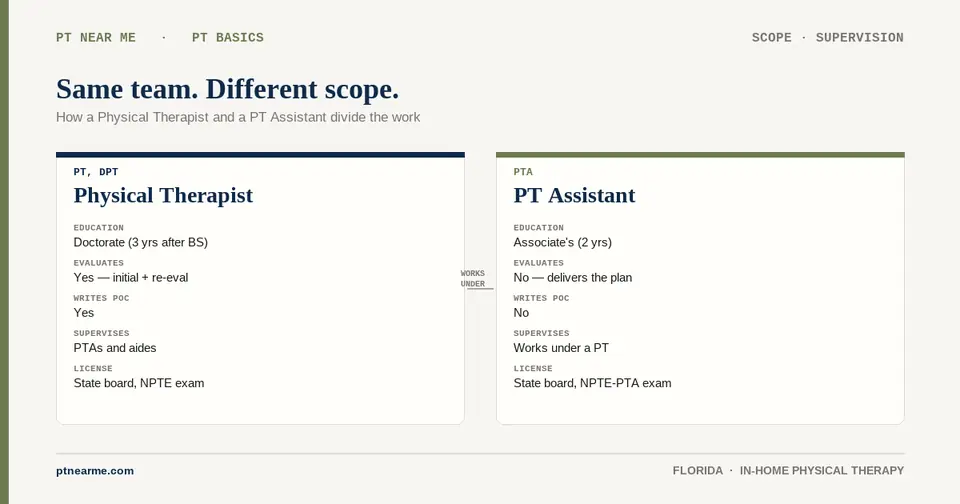
When you're scheduled for physical therapy, the person who walks through the door might be a Physical Therapist or a Physical Therapist Assistant. Both are licensed clinicians, both are trained to put hands on patients, and both want the same outcome you do. They are not, however, interchangeable. Scope of practice, education, and clinical authority differ in ways that affect how your care is run and who is accountable for decisions.
This is worth understanding for two reasons. First, you should know who's responsible for the clinical reasoning behind your plan — that's always the PT, even on visits where you're working with a PTA. Second, if you ever feel your program isn't progressing or something doesn't fit, the right person to bring that concern to is the supervising PT, who has the authority to change the plan.
Core responsibilities: PT vs. PTA
| Responsibility | Physical Therapist (PT) | Physical Therapist Assistant (PTA) |
|---|---|---|
| Initial evaluation | Performs every initial evaluation | Cannot evaluate |
| Diagnosis of movement disorder | Makes the diagnosis | Cannot diagnose |
| Writing the plan of care | Authors the plan | Cannot write the plan |
| Modifying the plan | Authorized to modify | Cannot modify without PT approval |
| Hands-on treatment | Provides treatment | Provides treatment under PT supervision |
| Progressing exercises within the plan | Yes | Yes, within parameters set by the PT |
| Discharging the patient | PT decision | Cannot discharge |
| Documentation | Initial eval, progress notes at re-eval, discharge | Daily session notes |
In practice, this means your first visit is always with a PT — a Doctor of Physical Therapy who examines you, identifies the movement problem, and decides what the plan should look like. Subsequent visits may be staffed by either a PT or a PTA, depending on the case, and the supervising PT re-evaluates at intervals required by state law and payer rules.
Education and licensing requirements
Physical Therapist (PT)
- Bachelor's degree (typically four years) with prerequisites in anatomy, physiology, biology, chemistry, physics, statistics, and psychology.
- Doctor of Physical Therapy (DPT) program (three years) accredited by CAPTE, including roughly 30 weeks of full-time clinical internships across orthopedic, neurologic, acute care, and outpatient settings.
- Pass the National Physical Therapy Examination (NPTE).
- State licensure in every state where the PT practices. Florida licensure is regulated by the Florida Board of Physical Therapy Practice.
- Optional board certification through the American Board of Physical Therapy Specialties (ABPTS) in areas like orthopedics (OCS), neurology (NCS), sports (SCS), and geriatrics (GCS), each requiring additional supervised hours and an exam.
Physical Therapist Assistant (PTA)
- Associate of Applied Science (AAS) degree from a CAPTE-accredited PTA program (two years), including roughly 16 weeks of clinical experience.
- Pass the National Physical Therapist Assistant Examination (NPTE-PTA).
- State licensure or certification — requirements vary by state.
- Continuing education to maintain licensure.
The headline number — seven or eight years for a PT versus two for a PTA — understates how different the two programs are. A DPT curriculum includes differential diagnosis, pharmacology, imaging interpretation, and clinical reasoning to the level that a PT can act as a primary care provider for movement disorders. A PTA program is intensely practical: how to deliver treatments safely, how to recognize when something has changed, and when to escalate.
Where PTs and PTAs work
Both roles work across the same settings: hospitals, outpatient orthopedic clinics, skilled nursing facilities, home health, schools, sports performance, and increasingly mobile and in-home practices like ours. The mix of PT and PTA staffing varies by setting and case complexity. A complex post-stroke patient learning to walk again is typically PT-heavy. A patient months into a knee replacement progression doing therapeutic exercise can be safely managed by a PTA with PT oversight.
In Florida, mobile PT practices generally staff a PT for every initial evaluation and re-evaluation, with PTAs delivering treatment sessions in between. State law sets the supervision standard — PTAs in Florida must be supervised by a licensed PT, with the supervising PT responsible for the plan of care and clinical decisions.
Choosing between PT and PTA as a career
If you're weighing the two paths as a career, the trade-off is real. The PTA route gets you into the workforce in about two years with substantially less debt and strong job growth, but caps your clinical authority and earning ceiling. The PT route requires a doctorate, six-figure debt for most graduates, and a longer runway — in exchange for autonomy, the ability to open your own practice, and significantly higher earning potential.
Many clinicians start as PTAs and bridge to PT later. The bridge isn't trivial — you still need a bachelor's degree and to complete a full DPT program — but PTAs come in with clinical experience that strengthens their performance in graduate school. Either path is meaningful work; the choice is mostly about how much time and education you want to invest upfront and how much clinical decision-making you want to own.
Salary and job outlook
Both careers have strong demand, driven by an aging population, a steady rise in chronic musculoskeletal conditions, and growing recognition that physical therapy is an effective alternative to opioids and elective surgery for a wide range of presentations. The Bureau of Labor Statistics projects double-digit growth for both roles over the current decade.
Physical Therapists
Median annual pay for PTs sits in the mid- to high-$90,000s nationally, with a typical range from the mid-$70,000s to the low-$120,000s depending on setting, geography, and years of experience. Outpatient orthopedic clinics, hospitals, skilled nursing facilities, home health, and travel PT each pay differently, and Florida sits roughly mid-pack among states. Board-certified PTs and clinic owners can earn well above the median.
Physical Therapist Assistants
Median annual pay for PTAs sits in the low-$60,000s nationally, with a typical range from the mid-$40,000s to around $80,000. PTA job growth is projected to outpace the average for all occupations and has been one of the fastest-growing healthcare roles in recent BLS releases. Setting matters: home health and skilled nursing tend to pay higher than schools or sub-acute rehab.
Compared head-to-head, PTs earn more but invest more in education. PTAs hit the workforce earlier with less debt and a strong growth runway, but their earning ceiling is lower without further education.
How PTA supervision actually works in Florida
Supervision isn't a vague concept — it's defined in state practice acts and payer rules, and it shapes how the day-to-day care of a patient is actually delivered.
What the supervising PT is responsible for
- The initial evaluation and the written plan of care.
- Regular re-evaluation at intervals set by state law and payer policy.
- Modifying the plan when the patient's status changes — only the PT can do this.
- Final discharge and the discharge summary.
- Overall clinical and ethical accountability for the patient's care.
What a PTA can do under that supervision
- Deliver the interventions in the plan of care — therapeutic exercise, neuromuscular re-education, manual therapy techniques within their training, gait training, treatments.
- Progress exercises within the parameters the PT defined (more reps, more resistance, harder variations).
- Document each treatment session and the patient's response.
- Identify changes that need PT attention and escalate them.
Florida's standard for outpatient PT is "general supervision," which means the supervising PT must be available by phone or other means and must regularly review the PTA's documentation and the patient's progress. The PT does not have to be physically on site for every PTA visit, but the PT must be accessible and accountable.
How PT Near Me staffs cases
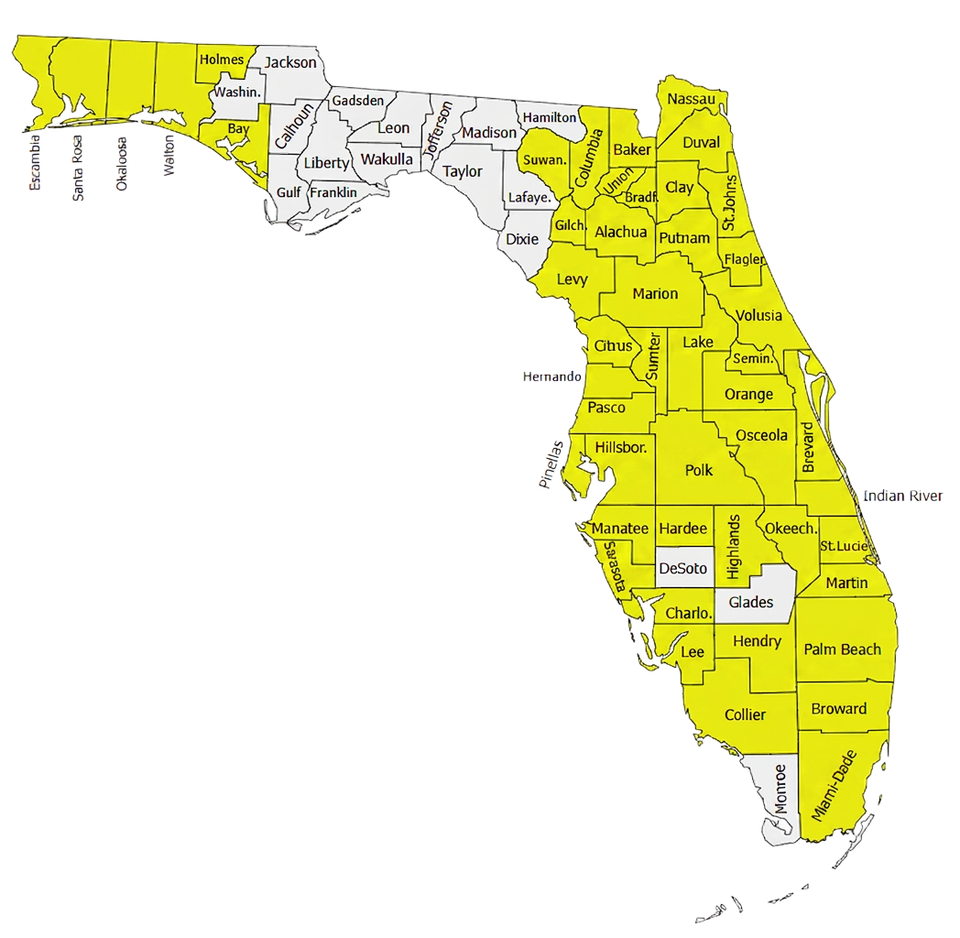
Our team is made up of licensed physical therapists across 50+ Florida counties. For post-auto-accident cases — which is most of what we do — the case is typically PT-led from start to finish because the early visits require ongoing clinical judgment about red flags, pain behavior, and progression. We bill the patient's auto insurance for crash-related care; we do not bill regular health insurance or Medicare.
When a PTA is part of a case, the supervising PT meets the patient on day one, writes the plan, and signs every re-evaluation. PTA-delivered sessions follow the same plan with the same documentation standard, and the PT reviews the chart on a defined cadence. That structure is how the role distinction is supposed to work — the credential matters, but so does the workflow that makes the credential meaningful. A PT signature on the plan of care without active oversight is a paperwork exercise; we treat it as an accountability one.
If you're a referring physician, the practical effect is that you get evaluation and re-evaluation notes signed by a Doctor of Physical Therapy who is actively managing the case, and PTA-delivered treatment is held to the same documentation standard with PT review on the schedule Florida practice rules and your patient's payer require. There is no ambiguity about who is responsible for clinical decisions.
Related reading
Frequently asked questions
- Will I always see the same clinician?
- Continuity is a priority, so most patients see the same primary clinician through their episode of care. If a PTA is part of the team, they work under the same PT who evaluated you, with the same plan in front of them.
- Can a PTA change my exercises?
- A PTA can progress or regress exercises within the parameters the supervising PT set in the plan of care — for example, increasing reps or adding resistance when you're ready. They cannot change the plan itself or add interventions outside what the PT prescribed.
- If I have a concern about my plan, who do I talk to?
- The supervising PT. Any clinician on your case can route the concern, but the PT is the one with authority to modify the plan. We make sure you have a direct way to reach them.
- Does insurance pay the same for a PT versus a PTA?
- Reimbursement rules vary by payer. For the auto-insurance cases we bill, treatment is documented and billed against the established plan of care regardless of which clinician delivered the session, with the supervising PT responsible for oversight.
- Can a PTA become a PT later?
- Yes, and many do. The bridge requires completing prerequisite coursework, earning a bachelor's degree if not already completed, and finishing a Doctor of Physical Therapy program. It's a serious commitment, but PTAs come into DPT programs with hands-on clinical experience that gives them an advantage.
- How are PTs and PTAs regulated in Florida?
- Both are licensed by the Florida Board of Physical Therapy Practice. PTs are required to complete continuing education on a defined cycle, and the same applies to PTAs. License status, disciplinary history, and continuing-education compliance are all matters of public record through the Florida Department of Health.
Related articles
- PT Basics & Glossary
Physical Therapy Terminology: A Plain-English Guide to PT Lingo
A patient-friendly guide to the words, abbreviations, and movement terms physical therapists use every day — so you can follow your plan of care and ask better questions.
PT Near Me · June 22, 2026
- PT Basics & Glossary
The Ultimate Physical Therapy Cheat Sheet for Patients and Clinicians
A practical reference for how good PT works: evaluation, SOAP notes, SMART goals, common treatments, and the documentation patients have every right to ask for.
PT Near Me · June 22, 2026
- In-Home PT
Mobile Physical Therapy: The In-Home PT Guide for Florida Patients
How mobile, in-home physical therapy actually works in Florida — from referral and first visit to discharge — and when it's the right level of care.
PT Near Me · June 22, 2026
In your city
Conditions we treat across Florida
Each guide below covers the clinical evidence, recovery timelines, and coverage details specific to these conditions.
Don’t see your city? View all Florida service areas.
Florida-licensed physical therapists covering 50+ counties in Florida.
Our clinicians reach major metros and rural communities alike — from the Panhandle to the Keys. Patients are typically seen at home or at their workplace within 48 hours of a complete referral.
- Clinicians on our team
- Statewide
- Florida counties covered
- 50+
Need to refer a Florida patient?
Our intake team confirms auto insurance coverage during the call and schedules most patients at home or at their workplace within 48 hours.